Corporate And Business Law

Violares Law

Lawyers and Legal Consulants

CYPRUS LAW MANUAL

Corporate and Business Law
Revised Edition

Law reviewed to August 2026

Miltiades J. Violares | Barrister at Law

Violares Law LLC | Nicosia, Cyprus | violareslaw.com

Preface

This revised manual provides an educational introduction to selected principles of Cyprus law relevant to commercial and corporate practice.

The law is stated as reviewed on 6 August 2026. Legislation, procedural rules, administrative practice and case law change. Readers must consult the legally binding Greek text in the Official Gazette, the latest consolidated legislation and applicable transitional provisions. This manual does not create a lawyer–client relationship and is not a substitute for advice on particular facts

Contents

  1. The Cyprus Legal System
  2. The Law of Contract
  3. Employment Law
  4. The Law of Agency
  5. Partnership
  6. Corporations
  7. Corporate Administration
  8. Capital and Financing
  9. Corporate Officers
  10. Insolvency
  11. Fraudulent Behaviour

Chapter 1 - The Cyprus Legal System

Sources of Cyprus Law

A. Constitution

  • Is the product of the London and Zurich Agreement
  • Establishes a Presidential System (Sui Generis)
  • Provides the Supreme Law (Article 179 + The Police v Georgiades).
Note ➔ After the 5th amendment constitution is the supreme law provided it complies with EU law.
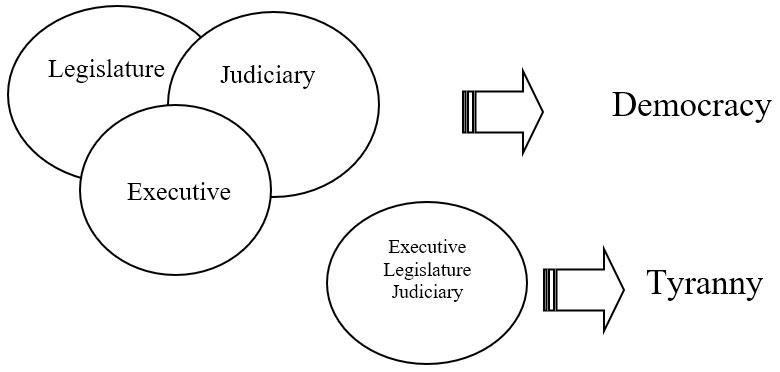
Separation of Power:
Separation of Power: Democracy vs. Tyranny Diagram
Separation of Powers: Legislature, Judiciary, Executive (Democracy vs. Tyranny)

B. Doctrine of Necessity

Attorney General of the Republic v Mustafa Ibrahim (1964)

Issue: Whether Law 33/1964 had been in accordance with the Constitution

Held: The law of necessity allows certain deviations from the rigid Constitutional text.

Triantafyllides J: “...the legal doctrine of necessity in public law is in reality the acceptance of necessity as a source of authority for acting in a manner not regulated by law but required, in prevailing circumstances, by supreme public interest, for salvation of the State and its people”
⇒ A mechanism to deal with abnormal situations, which render the operation of the State Impossible
Prerequisites for the application of the law of Necessity:
  1. (i) There must be an imperative and inevitable situation of necessity of exceptional circumstances.
  2. (ii) No other remedy is available.
  3. (iii) Measures taken must be proportional to the necessity at issue.
  4. (iv) Measures taken are of temporary character limited to the duration of the exceptional circumstances called to cure.
Attorney General of the Republic v Mustafa Ibrahim (1964)

Issue: Whether Law 33/1964 had been in accordance with the Constitution

Held: The law of necessity allows certain deviations from the rigid Constitutional text.

C. International Treaties and Conventions

Article 169 C: International treaties enjoy a superior force than any other Domestic legislation.

Malachtou v Armefti
“...agreements duly ratified...have a superior force to municipal law from the date of their publication in the Official Gazette...”

D. The Laws of Cyprus

Legislation / Statute law: It is usually made in areas so complicated or unique where common law alternatives are unlikely or would take too long to develop.

Primary Legislation – Acts of House of Representatives:

The Hof R can make law as it sees fit, or as directed by the EU. Hof R makes new law and repeals and overrules old law.

Secondary / delegated Legislation:

Most of the times is a law of detailed nature, made by subordinate bodies who have given the power to do so by statute (i.e Council of Ministers).

2 forms of Delegated legislation:
  1. (i) Statutory Instruments: Made by Persons (i.e. income tax & vat Reg)
  2. (ii) By-Laws: Made by local authorities (i.e. to regulate professions like Accountants)

E. Laws in force prior to independence

Article 188 C: In force as long as they do not contradict with constitutional provisions.

F. Law and Principles of the Vakouf

Turkish religious properties Law.

G. Case-Law

The basis of the case law is that the law is interpreted by the courts and evolves as cases are heard ➔ It is a Judge-made law

The doctrine of
Judicial Precedence

Judicial precedence is based on the view that the function of the judge is to decide cases in accordance with existing case law.

i.e. Judges of lower courts have a duty to follow cases/judgments of the Supreme Court. Precedent of the Supreme Court has to be followed in accordance with certain rules.

Rules:

1. It must form part of the ratio decidendi of the case

Ratio Decidendi: The statement of Law on which the Judge based his/her decision which is binding on later decisions. It is the core of the decision and most of the times has nothing to do with the facts of the case (i.e. Donoghue v Stevenson).
Obiter Dicta: Other statements of Law which do not form the basis of the decision. These are not binding on future decisions but may assist judges in future trials as a persuasive authority.

2. Legal Precedent is formed only by Superior courts.

i.e. Decisions of the Supreme Court bind lower courts ➔ District Court is bound by precedents set by the Supreme Court

Note ➔ Precedent will not be binding:

H. Common Law & Equity

Common Law: This is the Law which applies to England and Wales and according to section 29(1)(c) of Law 14/60 is applicable to Cyprus.

Hadjitheodosiou v Koulia

Held: Cypriot Courts have an obligation to apply common Law by adjusting it to the conditions of the country ➔ Therefore English decisions according to this case if they are not overridden by statute, are applied in Cyprus only with regards to the principle that they establish and not their results.

Equity: A body of rules which was brought to introduce fairness into the UK legal system and offer alternative remedies when Legal Remedies were not sufficient.

Equity was developed in England into two directions:
  1. (i) Setting general principles of Justice (Maxims of Equity)
  2. (ii) Establishing new institutions (Trust)
  • It operates by remedifying the injustice of the proper application of common law (See promissory estoppel)

Hierarchy of Sources of Law

  1. 1 Constitution of the Republic of Cyprus (Art 179 C)
  2. 2 International Law (Art 169 C)
  3. 3 Laws of the Republic (Legislation & Case Law)
  4. 4 Delegated Legislation / Common Law & Equity / English Statutory provisions
➔ 5th Amendment: EU Law enjoys Supremacy over domestic legislation

Human Rights

Are Safeguarded by:

The Constitution (Part II Articles 6–35)

• All laws or administrative actions in contrast with HR = Void

• Breach of constitutional provision: Right to an action to the Supreme Court

The European Convention of Human Rights

Cyprus has ratified and adopted the Convention by Law 39/62 and by that time the convention is incorporated to the national law with superior force.

Some of the rights and Liberties:
  • Right to life
  • Right to liberty and Security
  • Right to a fair trial
  • Freedom of Expression
  • Prohibition of torture
Note ➔ An application to the European Court of Human Rights must normally be lodged within four months of the final domestic decision, subject to Article 35 ECHR and the Court's admissibility rules.

The Structure of the Courts of the Republic

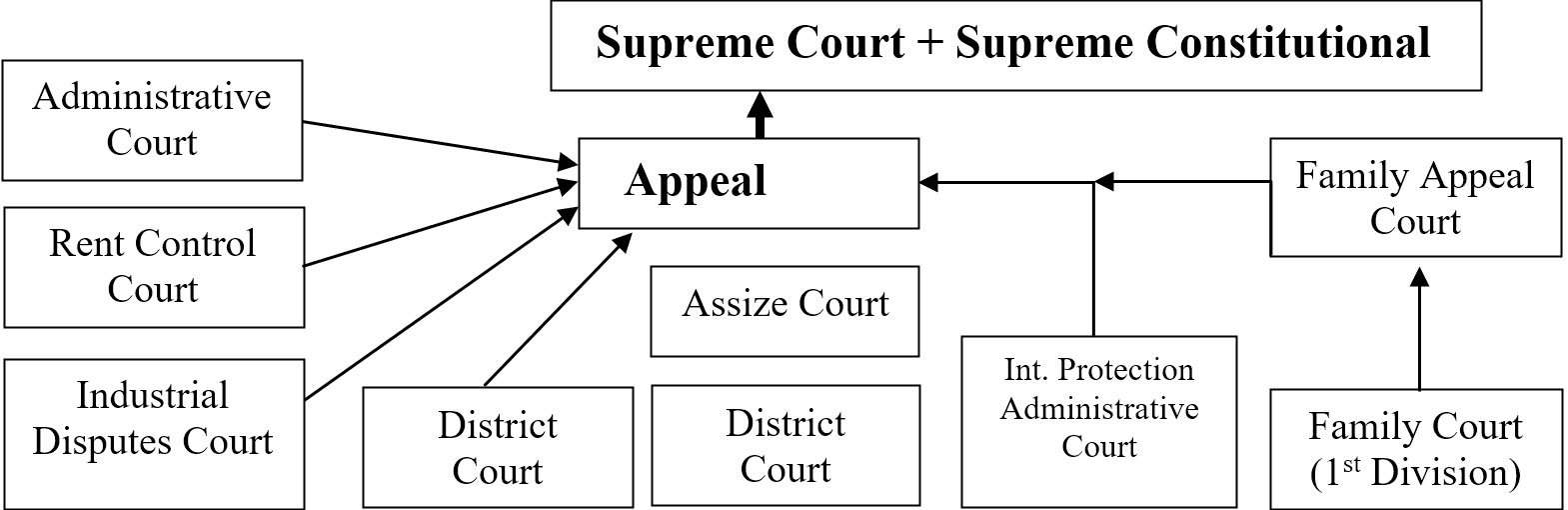
Since 1 July 2023, Cyprus has a three-tier appellate structure. A separate Court of Appeal is ordinarily the second-instance court for civil and criminal matters. At the apex, the Supreme Court exercises the civil and criminal jurisdiction assigned by the Constitution and Law 33/1964, including specified third-instance jurisdiction subject to leave, while the Supreme Constitutional Court is the apex court for constitutional and administrative/revisional matters.

The Court of Appeal may sit in civil, criminal and revisional divisions. New Civil Procedure Rules entered into operation in 2023 and require cases to be dealt with justly and at proportionate cost. Any legacy court diagram below must be read subject to this revised structure.

The Structure of the Courts of the Republic Diagram
Figure 1.2: The Structure of the Courts of the Republic (Appellate Hierarchy & Specialized Jurisdictions)
Supreme Court
7 Judges
Original Jurisdiction:
  • All matters of admiralty jurisdiction
  • Electoral Court
Appellate Jurisdiction:
  • All matters of original Jurisdiction
  • All appeals from decisions of Supreme Court Judges sitting alone
  • Decisions of Appellate Court on Civil matters of Major Public importance or General Public Interest or of Conflicting inferior Decisions.
Further Powers:
  • Issue prerogative orders (Habeas Corpus, Mandamus, Prohibition, Quo Warranto, Certiorari)
Supreme Constitutional Court
9 Judges
  • All constitutional matters
  • Rules on matters as to the constitutionality of any legislation
  • Decisions of Appellate Court on Civil matters of Major Public importance or General Public Interest or of Conflicting inferior Decisions.
Appeal Court
16 Judges
  • All decisions of inferior courts except Family Courts
Inferior Courts
  • Administrative Court: Article 146 of Constitution
  • International Protection Administrative Court: Asylum Law / Asylum applications – Refugee Law.
  • The Assize Court: All serious Criminal Offences
  • The District Courts: All Civil and Criminal offences within territorial Jurisdiction
  • Specialized Courts: Rent Control Court, Industrial Disputes Court, Family Court (1st Division), Family Appeal Court

Chapter 2 - The Law Of Contract

The Law of Contract in Cyprus

  • Article 26 C: Everybody has the right to be a party into a Contract
  • Chapter 149: Codifies the UK Law of Contract (1931) ➔ The basic Legislation in Cy
Contract ⇨ A legally binding Agreement between two or more parties. A valid contract is enforceable by law, which means that when any dispute arises between the contracting parties, an action can be initiated to a Court of Law.

Essential elements of a valid contract

  1. 1. Agreement

    Offer + Acceptance (Without qualifications)

  2. 2. Intention to Create Legal Relations

    The Contracting parties intend to be subject to Legal consequence if any breach arises ➔ NOT when your dad offers to buy to you a new car if you pass your Law exams

  3. 3. Consideration

    Loss or Detriment in return for the benefit received ➔ In a contract for a haircut, the customer gets his/her hair cut (benefit) and in return pays the price (detriment).

  4. 4. Capacity

    This is the power/ability of a person to be able to be a party to a contract

    Minors (-18): Are capable to become a party to a contract only:

    (i) For the provision of the necessary goods (i.e clothes/medical attention etc)

    (ii) Necessary contract beneficial to minors (i.e contract of employment)

    ⇨ Not for loans/unnecessary goods > unless the minor ratifies them within reasonable time of reaching 18

    Mentally incapable persons: Have capacity to contract only if they understand the consequences in forming a contract.

  5. 5. Form

    Some contracts must follow certain formal requirements prescribed by law (Most of the contracts don’t ➔ An oral agreement is as much binding as a written one)

    Examples of contracts that need to be made in writing:

    1. (i)
      Bonds in customary form (s.78 CAP 149)
    2. (ii)
      An agreement made without consideration if it is expressed in writing and signed by the party to be charged therewith , and it is made on account of natural love and affection between parties standing in a near relation to each other (s. 25 CAP 159)
    3. (iii)
      Pledge of bills of exchange, promissory notes (s138 CAP 149)
    4. (iv)
      Guarantees
    5. (v)
      Transfer of shares in a limited liability company
  6. 6. Not illegal or contrary to public policy

    The purpose of the Contract must be legal. If it is not legal then it is void. Furthermore the law lists certain contracts that are void:

    1. (i)
      Contracts for an unlawful object
    2. (ii)
      Contracts without consideration
    3. (iii)
      Contracts in restraint of marriage
    4. (iv)
      Contracts in restraint of trade
    5. (v)
      Contracts in restraint of legal proceedings
  7. 7. Free Consent ➔ Vitiating Factors

    (Contracts not made by undue influence or duress or misrepresentation or mistake )

Arrow Down
Effect of failure to satisfy the above requirements ….

Void: No legal effect on either party / As if there was NO contract formed in the first place.
Example: A contract lacking consideration is void.

Voidable: A valid contract, unless and until it is brought to an end at the request of one of the parties (usually the innocent party). The exercise of this option is known as Rescission. So… one or more parties have the power to either ratify (keep the contract alive) or avoid it.
This can take place when the person enters into a contractual relation by oppression (when someone holds a gun to your head.

Note:

➔ Property transferred under a void contract must be handed back to the transferor.

➔ If the transferee retains goods s/he could be sued by the real owner for wrongful detention.

Unenforceable Contracts: Contracts that have some legal consequences, but they aren’t enforceable in an action for damages due to a defence (i.e limitation period - 6 years).

AGREEMENT

What is an offer?
Offer ➔ S. 2(2)(a)
  • A Definite & Unequivocal statement of willingness to be bound on specific terms with the intention that, upon acceptance a legally binding contract will be formed.
  • An offer can be made Expressly (orally or in writing) OR by Implicitly (by conduct)
  • Can be made to: A Specific person / A class of persons / To the whole world
Bilateral/Unilateral Contracts

Bilateral: Each party undertakes obligations. There is an exchange of promises and the parties are bound by their promises. (i.e Contract for sale: The seller transfer goods and the buyer pays the price)

Unilateral: Only one party makes promises and the other is free to choose whether to perform or not. However, once the one party chooses to perform, the party making the promise is bound. ( Carlill v Carbolic Smoke Ball)

Examples:

Andreas says to Maria, “if you kiss me, I will give you a euro” ➔ This is a unilateral contract; Andreas wants a kiss not a promise to kiss.

If instead he says, “If you promise to kiss me, I promise to give you a euro” ➔ If Maria promises to kiss him there is a bilateral contract.

Requirements of a Valid Offer?
1. Definite & Unequivocal offer

Must be clear/not vague or uncertain in its interpretation

Example: Jimmy offers to buy “some of Michael garden equipment for €100”. Could a contract results?

Answer: No. Jimmy offer is too vague. “Some of” does not create an offer sufficiently certain to be enforceable; a court could not supply the missing terms to fulfil the intent of the parties.

+ The statement made must sufficiently identify the offeree (person whom the offer is made) in order for the statement to constitute an offer ➔ No one except the offeree (or the class of offerees) can accept an offer; for example if you are in the football field and an offer is made to someone else, you can’t turn around and accept the offer, simply because you are not the offeree.

2. Show an Intention/Willingness to be bound

The offeror must not merely negotiating

Gibson v Manchester City Council: a letter stating “may be prepared to sell”
Not clear willingness to be contractually bound

Note ➔ In deterring if there has been an offer, look to see if the communication is a promise. Consider language, circumstances, prior practice and relation of parties, method of communication and industry customs (Language like “I am asking”, “I ‘d consider” typically are words inviting negotiation).
3. Communication of the offer must take place

An offer is effective only when it is communicated to the offeree. The offeree must know of the offer. If there is acceptance without any knowledge of the offer ➔ there is no contract (See R v Clarke)

s.4 (1) CAP 149: communication of an offer is effective only when it comes to the knowledge of the offeree

What is NOT an offer?

An Invitation to treat is not an offer. This is an indication that a person is ready to accept offers with a view to contract. This is not an offer but only an invitation to others to make an offer. In contrast an offer is a statement that if accepted there will be a contract without further negotiations. Invitation to treat takes place usually at the starting point of negotiations.

The following are some examples recognised by the law:

Most advertisements

General rule: an advertisement is an invitation to treat, not an offer, as shown in:

Partridge v Crittenden (1968)

Facts: The defendant put the following advertisement in a magazine: ‘Bramblefinch cocks and hens, 25s each’.

Held: This was an invitation to treat and not an offer. The advertisement stated that the birds were for sale, not that the seller would sell to all comers.

Exception to an advertisement not being an offer :

Note, however, that it would be an offer if no further negotiations were intended or expected. This is the position in Carlill v Carbolic Smoke Ball Co (1893), where the advertisers made it clear that they would pay money to anyone complying with the terms of the advertisement.

Carlill v Carbolic Smoke Ball Co (1893)

Facts: The manufacturers of a medicinal ‘smoke ball’ advertised in a newspaper that anyone who bought and used the ball properly and nevertheless contracted influenza would be paid a £100 reward. Mrs Carlill used the ball as directed and did catch influenza. The defendant claimed that there was no enforceable contract because Mrs Carlill had never notified the company that she accepted its offer

Held: The court rejected the defendants’ argument on the basis that the wording of the advert was such that Mrs Carlill needed only to comply with the terms of the offer and there was no further negotiations intended. Once Mrs Carlill had satisfied the conditions she was entitled to enforcement of the contract. Furthermore, weight was placed on the £1000 bank deposit that claimed to 'show their sincerity in the matter' in showing that the advertisement was not just a mere 'puff'.

Shop window displays

General rule: an advertisement is an invitation to treat, not an offer, as shown in:

Fisher v Bell (1961)

Facts: The Restriction of Offensive Weapons Act 1959 creates a criminal offence of ‘offering for sale’ certain offensive weapons. A shopkeeper was prosecuted under this statute for displaying a flick knife in his shop window, and thus 'offering it for sale'.

Held: A window display was not an offer of sale, but only an invitation to treat. So the display did not infringe the law.

Goods on shop shelves

Pharmaceutical Society of Great Britain v Boots Cash Chemists (1953)

Facts: Statute requires that the sale of certain pharmaceuticals must be carried out under the supervision of a qualified pharmacist. Boots operated a store where the drugs were displayed on a self-service basis and the customers paid at a cash desk for the goods they had selected. A pharmacist was present at the cash desk but not at the shelves where the goods were displayed with a price tag. The Pharmaceutical Society claimed that the statute was being contravened.

Held: The display of goods in a shop was not an offer, but an invitation to treat. It was the customer who made the offer and Boots could either accept or reject this offer at the cash desk (in the presence of the qualified pharmacist). The act constituting the acceptance is the ringing up of the price on the till by the cashier and at that moment a binding contract of sale is made.

Mere statement of Intention

Harris v Nickerson (1873)

Facts: The defendant placed an advertisement in London papers that certain items, including some office furniture would be placed up for auction over three days. The claimant obtained a commission to buy the office furniture and expended time and expense to travel to bid for the office furniture. On the third day, the lots for the office furniture were withdrawn. The claimant sued for loss of time and expense.

Held: An advertisement that goods will be put up for auction does not constitute an offer to any person that the goods will actually be put up, and that the advertiser is therefore free to withdraw the goods from the auction at any time prior to the auction.

Also

A statement of the price

An offer must be distinguished from a mere supplying of info. The statement of a price in answer to an enquiry is not necessarily an offer to sell at that price.

Auction Sales

No offer is made by putting the goods up for bidding. The offer is made by the bidder and accepted by the auctioneer by the fall of the auctioneer’s hammer (the opposite takes place when there is a reserve price).

Inviting Tenders

Usually is not an offer except if accompanied by words indicating that the highest or the lowest tender will be accepted.

Termination of an Offer?

Once an offer has been terminated, it cannot be accepted. An offer can be terminated by:

Revocation

Routledge v Grant (1828)

Facts: G offered to buy R’s horse and stated that the offer would remain open for six weeks. However, before the six week period had elapsed, G withdrew the offer.

Held: G was entitled to withdraw the offer at any time before acceptance.

The revocation must be communicated to the offeree, i.e. it must be brought to his actual notice.

Open Offer

When the offeree chooses to pay the offeror (provide consideration) to keep the offer open, s/he is said to have bought an option. Option contracts are separate binding contracts, breach of which (i.e revocation before the time has elapsed) will give a claim to damages.

Rejection
  1. i.
    By not accepting
  2. ii.
    Counter Offer: a new offer in response to the original offer. This is a new offer, which terminates the former one, which can either be accepted or rejected

Hyde v Wrench (1840)

Facts: Wrench offered to sell Hyde a farm for £1,000. Hyde made a counteroffer, by offering £950. Wrench rejected this. Later Hyde came back and said that he now accepted the original offer of £1,000. Wrench rejected it.

Held: Hyde could no longer accept the original offer. It had been terminated by the counteroffer and was no longer capable of acceptance. His ‘acceptance’ was merely a fresh offer which Wrench was free to turn down.

Note that a mere request for further details does not constitute a counteroffer.

Lapse of Time
  • When there is specific period for acceptance: The offer will lapse after the expiration of this period.
  • When there is no Specific period: The offer will expire after the lapse of a reasonable time.
  • If the offer was made subject to a condition: The offer will expire after a failure to perform the condition.
What is an Acceptance?
ACCEPTANCE
S7(a)
  • Absolute & Unconditional assent to all the terms of the offer (while the offer is still open). Mirror Image rule: The acceptance must be absolute and respond exactly to the terms of the offer.
  • An acceptance can take place Expressly (orally or in writing) OR by Implicitly (by conduct).
  • Silence cannot be a stipulated method of acceptance ( Felthouse v Bindley: an offeror cannot impose contractual liability on an offeree merely by proclaiming that silence shall amount to acceptance).
  • S 7(b) > An offeror may stipulate a method of acceptance. If s/he does so, the offeree must follow the specific method of acceptance, otherwise there will be no acceptance.

Note: as long as the offer is valid (subject to the rules above) acceptance will create an agreement.

Example: Einstein, as a joke, tells Leonardo, “I ‘ll sell you my chemistry set for €5”. Leonardo, who has no idea that the plutonium alone in the set worth a fortune says, “I accept”. Could this be a valid contract?

➔ Yes. Leonardo could reasonable have assumed that Einstein’s statement created an immediate power of acceptance in him. The fact that Einstein was joking is irrelevant what counts is the acceptance of a valid offer. (However, if Leonardo knew that Einstein had a very dry sense of humour and realized that he was joking on the first place – there wouldn’t be an offer).

Communication Rules ➔ CAP 149

Section 4:

(1) Communication of an offer is effective when it comes to the knowledge of the offeree.

(2) Communication of acceptance of an offer is effective:

(a) In respect to the offeror, when acceptance has left the authority of the offeree and is in transit to the offeror

(b) In respect to the offeree, when acceptance is received by the offeror

(3) Communication of revocation of offer or acceptance is effective:

(a) In respect to the revoking party when revocation has left his/her authority and is in transit to the receiver

(b) In respect to the receiver, when revocation is received by him/her

Section 5:

An offer may be revoked at any time before communication of acceptance is effective in respect to the offeror and not later, whereas acceptance may be revoked at any time before its communication in respect to the offeree, but not later.

Intention to Create Legal Relations

All contracts are agreements, but not all agreements are contracts since some agreements are not intended to be legally enforceable (i.e invitation to a lunch). In the cases where there is no intention to create legal relations the parties cannot sue and enforce rights acquired by the agreement.

Where there is no express statement as to intention to create legal relations, the courts apply two rebuttable presumptions:

DOMESTIC/SOCIAL ARRANGEMENTS

GR: In agreements between members of the family and friends there is a rebuttable presumption that there is no intention that the agreement was to be legally binding upon the parties.

Balfour v Balfour (1919)

Facts: The defendant, who was about to go abroad, promised to pay his wife £30 per month in consideration of her agreeing to support herself without calling on him for any further maintenance. The wife contended that the defendant was bound by his promise.

Held: There was no legally binding contract between the parties. As it was a domestic agreement it was presumed the parties did not intend to be legally bound.

“In domestic and social arrangements there is a presumption that there is no intention to create legal relations”. This case covers spouses living together. (Not when separated/divorced > Merritt v Merritt)

PRESUMPTION CAN BE REBUTTED by the party who argues that there is such an intention. So… the party challenging this, has to prove that even if the arrangement was a domestic one, there was always an intention that the parties were legally bound.

Examples where the presumption is rebutted:

  1. (i)
    Use of Deed (Formal arrangements)
  2. (ii)
    When there is detrimental reliance on the faith of the agreement
  3. (iii)
    When usage of words and surrounding circumstances prescribe so

Simpkins v Pays (1955)

Facts: Pays and her granddaughter, together with Simpkins, a paying lodger, submitted an entry each week in a fashion competition appearing in the Sunday Empire News. All three devised a separate solution to the competition, but they were submitted on one coupon only, in Pays’ name. The entry fees and postage were shared equally. The granddaughter made a correct forecast and Pays received a prize of £750. Simpkins claimed 1/3 share of the prize money.

Held: Although this was an arrangement in a domestic context the presumption was rebutted: it was a legally enforceable joint enterprise and the parties clearly intended to share any prize money. It was decided that on the facts this went beyond a mere friendly agreement.

COMMERCIAL ARRANGEMENTS

GR: Parties involved in ordinary commercial dealings ➔ Presumption that there is intention to be legally bound.

➔ Courts are reluctant to rebut the presumption, so there is always a need for clear evidence to the contrary ➔ for the PRESUMPTION TO BE REBUTTED there must be a statement in the contract saying “the agreement is not legally binding”

Jones v Vernon’s Pools Ltd (1938)

Facts: Jones contended that he had forwarded a winning entry to the defendant company of football pools promoters, but they denied having received it. In order to deal with this type of eventuality, a clause was printed on the pools coupon which Jones had signed, stating that ‘any agreement … entered into … shall not … give rise to any legal relationship … but … is binding in honour only’.

Held: A contract did not exist between the parties, since the wording of the agreement clearly negated any such intention. Jones could not, therefore, sue the pools company for breach of contract.

CONSIDERATION

GR: Contract not supported by consideration is void (S.25 CAP 149)

Definition: s. 2 (2) (d): when upon the request of the offeror, the offeree or any other 3rd party proceeds or will proceed into an action or inaction in relation to the contract.

“Some right, interest, profit or benefit accruing to one party, or some forbearance, detriment, loss or responsibility given, suffered or undertaken by the other” ( Currie v Misa)

Types of Consideration?
Executory consideration

Executory consideration is given where there is an exchange of promises to do something in the future.

Executed consideration

Executed consideration means that the consideration is in the form of an act carried out at the time the contract is made.

Consideration Rules?
(A) Consideration must be sufficient but need not be adequate

Sufficient means that:

  • there must be some monetary value to the consideration
  • it must be capable in law of amounting to consideration.

The words ‘need not be adequate’ mean that there is no need for each party’s consideration to be equal in value.

Chappell v Nestle Co Ltd (1959)

Facts: Records were sold for 1s 6d plus three chocolate wrappers.

Held: The wrappers were part of the consideration even though they had minimal value.

Thomas v Thomas (1842)

Facts: A promise to lease a house to a widow for rent of £1 a year was binding.

Held: The consideration had some value, and so was sufficient at law, even though it was inadequate as a year’s rent.

White v Bluett (1853)

A son’s promise to stop complaining did not amount to consideration as it had no monetary value.

(B) Past consideration

Past consideration is sufficient and therefore good consideration

Consideration is past if the consideration is an act which has been wholly performed before the other party gives his promise.

(C) Performance of an existing duty

As a general rule, performance of an existing statutory duty is not sufficient consideration.

Collins v Godefroy (1831)

Facts: A witness was promised payment if he would attend court and give evidence.

Held: This did not amount to consideration as he was legally required to attend court.

Not in:

Glasbrook Bros Ltd v Glamorgan County Council (1925)

Facts: Glasbrook Bros Ltd requested the police to provide protection in excess of the statutory requirement.

Held: The police had provided sufficient consideration to give entitlement to remuneration by providing the extra officers over and above the statutory requirement.

Similarly, performance of an existing contractual duty is not consideration:

Stilk v Myrick (1809)

Facts: A captain promised to share the wages of the deserting seamen (2) with the rest of the crew who had contracted to sail the ship home.

Held: The promise was not binding as there was no extra consideration from the seamen, they were merely doing what they had contracted to do.

Hartley v Ponsonby (1857)

Facts: A high number of desertions from a merchant ship (17) rendered the vessel unseaworthy since it was now undermanned. Extra pay was offered to the crew if they remained loyal and sailed the ship home.

Held: The promise of extra money was recoverable by the seamen who remained loyal, since they were now working in a dangerous situation not contemplated by their original contractual undertaking (i.e. they were doing more than required by their original contract).

The performance of an existing contractual duty may be sufficient if it confers some benefit of a practical nature on the other party.

Williams v Roffey Bros (1990)

Facts: W agreed to do some carpentry in a block of flats for R at a fixed price of £20,000, by an agreed date. The contract contained a ‘time penalty’ clause and R agreed to pay an extra £10,000 to ensure that the work was completed on time. If the work had not been completed on time, R would have suffered a penalty in his own contract with the owner of the flats.

Held: The Court of Appeal decided that, even though W was in effect doing nothing over and above the original agreement to complete the work by an agreed time, there was a new contract here for the £10,000. The court decided that both W and R benefited from the new contract. Two reasons were given:

  • Even though W merely did what he was already contracted to do, this nevertheless conferred a practical benefit on R in that R not only avoided penalties under the head contract, but also the cost and aggravation of employing substitute contractors.
  • R’s promise to pay the extra £10,000 had not been extracted by fraud or pressure. (It was R who had approached W and had volunteered the extra money.) It would be inequitable to go back on his promise.

⇨ The performance of an existing contractual obligation is sufficient consideration to support a promise from a third party.

Shadwell v Shadwell (1860)

Facts: The claimant was engaged to E (at this time an engagement was an enforceable contract). The claimant's uncle wrote him a letter saying "I will pay you £150 per year during my life until your income as a barrister shall reach 600 guineas pa" if you marry E. When the uncle died the claimant sought to recover outstanding amounts. The deceased's personal representatives argued that the claimant was already under a contractual obligation to marry when the uncle made the offer, and therefore the claimant supplied no consideration.

Held: There was sufficient consideration as the uncle had promised the claimant a reward and in return the uncle had received a promise to which he previously had no right. The contract was between the claimant and E. The uncle was a third party and the claimant promised to marry E in consideration of the payments.

PART PAYMENT

The problem: If A accepts €400 from B in full and final settlement of a debt of €500, can A sue for the remaining €100?

General rule – rule in Pinnel’s case (1602) states that payment of a smaller sum does not discharge a debt of a greater amount. So… part payment cannot satisfy a debt, and therefore the creditor can sue for the balance.

Exceptions
(A) Variation of terms at the Creditors request

If a new element is introduced = That gives sufficient satisfaction to support the creditor’s promise not to claim the balance of the unpaid debt >Examples:

  • Payment of the debt on a date earlier than originally agreed
  • Payment at a different place than the stipulated one
  • Payment of a lesser sum accompanied by the transfer of another item (i.e pay €50 + a book in satisfaction of €20 of the debt)
  • Payment in kind.
(B) Promissory Estoppel

The doctrine of promissory estoppel is based on the principles of fairness and justice. It prevents a person going back on his promise to accept a lesser amount.

Central London Property Trust v High Trees House (1947)

Facts: Claimants let a block of flats to the defendants in 1937 at an annual rent of £2,500 pa. The defendants were then going to sublet the flats. Owing to World War II and London being bombed, some of the flats became empty and it was impossible to re-let them. In addition the existing tenants had their rent reduced. The claimants agreed to accept half the rent for the rest of the war.

Held: The full rent was payable from the end of the war. The doctrine of promissory estoppel would stop the claimants from recovering the full rent foregone during the war years. High Trees House were expected to reduce their rent as a result of the rent reduction by Central London Property Trust, which they did thereby proving their reliance on the waiver.

The principle is subject to the following conditions:

  1. (i)
    There must be an existing contract between the parties.
  2. (ii)
    The claimants must voluntarily and freely make a promise and waive his rights.
  3. (iii)
    There must be an intention that the defendants should rely on the waiver.
  4. (iv)
    The defendants must alter their legal position because of the waiver.

PRIVITY OF CONTRACT

The Rule: Only the parties to a contract can sue and be sued under the contract.

Accordingly, only the parties to a contract:

  • acquire rights and obligations under it
  • can sue and be sued on it.
Exceptions
1. Where a beneficiary under a contract sues in some other capacity

Beswick v Beswick – widow suing as an administrator of her husband’s estate

Facts: A coal merchant sold his business to his nephew in return for a pension during his lifetime and the payment of a smaller pension to his widow, on his death. After the uncle died, the nephew stopped paying the widow. She sued the nephew in her own personal capacity and in her capacity as the administrator of her husband’s estate.

Held: Although she was not a party to the contract and could not sue in her own personal capacity, she could sue in her capacity as the administrator of her husband’s estate.

  1. 2. A principal may sue on a contract made by his agent

  2. 3. The holder of a bill of exchange may sue prior parties and the acceptor

  3. 4. Assignment of Debt: A debt owed by a defendant to a party who assigns the debt to a plaintiff gives the right to the plaintiff to sue the defendant, even if notice has not been given to the defendant.

Terms of a Contract

Contractual terms are the contents of a contract. These can include the agreed price, the date of delivery, method of payment etc.

Contractual Terms -vs- Mere Representations

The terms of a contract are introduced during the initial negotiations. However a statement, written or oral, made during negotiations leading to a contract may become a term of the contract or merely a representation inducing to the formation of the contract.

Why is it important to Differentiate?
Representation becoming a Term
Breach
Damages for breach + Remedies for Misrepresentation.
Representation NOT becoming a Term
Breach
Remedies only for Misrepresentation
How to distinguish between a Term & Representation

GR: Whether a statement becomes a term of the contract or not will depend outmost on the intention of the parties.

Objective test ➔ Depends on what was said and the circumstances in which the statement was made.

So… of vital importance are the following:

(i) Whether the statement was reduced in writing after it was made

Written agreements are more likely to become contractual terms ➔ Writing reveals an intention that the parties wish to be bound by the statements.

(ii) When the statement was made

The greater the interval of time between making the statement and concluding the contract, the more likely that it will be a mere representation.

(iii) The importance of the statement to the recipient

If the statement is a very important part of the contract / a statement that the other party is likely to rely on ➔ Most probably will be constructed as a Term

Bannerman v White: When the buyer makes it clear to the seller that he is only interested in a particular quality of goods, the specific quality of the goods becomes a term of the contract.

(iv) The Strength of the Statement

A suggestion during negotiations ➔ representation

However, forceful or emphatic assertions during the negotiation will most probably be classified as a term.

(v) Whether the person making the statement had any special knowledge or skill

If a person is expert in the relevant field or has certain info which is critical to the decision of the other party in making the contract ➔ Statements made from this person are more likely to become Terms of the contract

Dick Bentley v Harold Smith [Statement made by an expert]

Facts: B was interested in purchasing a Bentley car. H, a car dealer persuaded B to purchase a car with a replacement engine and a gearbox with only 20,000 miles. The assertion relating to the mileage was false.

Held: H statement became a term of the contract of sale. The special knowledge of the car dealer placed him in a better position than the purchaser.

Compare:

Oscar Chess v Williams [Statement made by a layman]

Facts: W, on selling a car to OC, car dealers, asserted that it was a 1948 model. The registration book appeared to confirm this, but it was in fact altered by previous owners of the car and the car was in fact a 1939 model.

Held: W statement was an innocent misrepresentation but not a term of the contract. The seller was not a car dealer with expected knowledge.

Express -vs- Implied Terms
Express Terms

Oral or Written which are specifically inserted into the contract by the parties.

Express terms must be clear & certain, so that the court is able to find the true intention of the parties. If the terms are not clear ➔ Contract is void (S.29 CAP 149)

King’s Motors v Lax“Such rent as may be agreed”

Note: The courts will try give meaning to an uncertain term where possible (i.e term can be ascertained by the previous course of dealings between parties (practice) or custom of the trade).
Implied Terms

Matters that are not expressly included in the contract by the parties but which nevertheless are still part of the contract.

(a) Terms implied by Courts
  • To give Business efficacy to the contract ( The Moorcock)
  • Terms implicitly required by the nature of the contract
  • Terms implied by Custom & Usage ( Foley v Classiques Coaches)

The courts may imply terms when the parties have failed to cover a particular matter, and without such terms the agreement remains unworkable / ineffective. The courts in doing so will be guided by the presumed intention of the parties and therefore including or not an implied term will depend on the facts of each case.

(b) Terms implied by statute

• Sale of Goods L10(1)/94 (Terms automatically included in the contract which can only be excluded in certain circumstances):

  • s.14: The seller has good title
  • s.15: Sale by Description ➔ Fit Description
  • s.16: Satisfactory quality / fit for purpose
  • s.17: Sale by sample

• Employment Acts: Health and Safety at work Act / Sex Discrimination Act / Equal Pay Act

GR: Express terms supersede implied terms (However, some statutory implied terms cannot be excluded even by express provisions or they can be excluded to a limited extend)

Classification of Terms
  • Conditions
  • Warranties
  • Innominate terms
The distinction is important when a contractual term is breached (broken).
Condition

A vital term of the contract, basic to the performance of the contract.

Breach of a condition ➔ 2 options:

  1. (i)
    The innocent party may treat the contract as repudiated (ended) and claim damages for any loss suffered.
  2. (ii)
    Affirm the contract and claim damages for any loss suffered.
Warranty

A less important term, incidental to the main purpose of the contract.

Breach of a warranty ➔ Does not cause the whole agreement to collapse. The innocent party can only claim damages but not repudiate the contract

How to distinguish between a Condition & Warranty

1. Statute may declare the category of the term

The statutory wording will clearly categorise > i.e Sale of Goods Law: There is always a condition that the seller has a right to sell.

2. Standard form contracts

Usually in this kind of contracts the various terms are described either as “conditions” or “warranties”

3. The parties expressly declare that a term is to be a condition

i.e time is declared to be of essence in the contract

Note: Mere use of the word condition or warranty is not itself conclusive, and if in conflict with the statute the statute prevails.

4. In the light of the circumstances

Where the contract gives no express guidance it is a question of fact in each case whether the parties regard the term as an important/vital one and so going to the root of the contract (condition) or whether it provides a term of lesser importance, collateral to the main purpose of the contract (warranty)

Poussard v Spiers [Condition: An opera singer to appear on the opening night]

Compare

Bettini v Gye [Warranty: An opera singer to appear for rehearsals]

Innominate
Term

This is an intermediate category of terms which are neither conditions nor warranties. The Courts depending on the nature and effect of the breach will award damages.

Hong Kong Fir Shipping v Kawasaki

How to distinguish Innominate Terms
Serious Breach
➔ As to deprive the injured party of substantially the whole benefit of the contract (fundamental breach)
➔ The injured party is entitled to terminate the contract.
Not Serious Breach
➔ Minor / Non-essential consequence
➔ The Innocent party may only claim damages but not terminate the contract.
Note: The question of classification of terms only arises if the injured party wishes to end the contract. If the injured party seek damages only, there is no need to consider the status of the term broken.

Exclusion Clauses

Definition & Effect: Terms which are included in written contracts (particularly standard from contracts) intending to exclude or limit the liability of one or more parties.

Validity of Exclusion Clause

The party who wants to avoid the exclusion clause can challenge its validity through the courts. The courts, in deciding whether the clause is valid or void will examine two tests:

Common Law Test

In order to be valid an exclusion clause must satisfy two conditions:

  1. (i)
    It must be incorporated into the contract
  2. (ii)
    Its wording must cover the loss

(i) An exclusion clause can be incorporated into a contract by:

Signature

The case of L’Estrange v Graucob (1934) established that a clause is incorporated by signature even if the signatory did not read or understand the document.

However, the situation in L’Estrange v Graucob (1934) can be contrasted with Curtis v Chemical Cleaning (1951) in which it was held that a signature does not incorporate the clause if the effect of the term was misrepresented.

Curtis v Chemical Cleaning (1951): Liability for damage to a wedding dress was not excluded due to misrepresentation of the clause.

Notice

For an exclusion clause to be incorporated by notice, reasonable steps must have been taken to bring it to the attention of the other party at the time the contract was made. What are ‘reasonable steps’ depend on the circumstances.

Thompson v LMS Railway (1930)

Facts: T bought a railway ticket, which stated that she would travel subject to the company’s standard conditions of carriage. These conditions could be inspected at the station; one of them excluded liability for injury to passengers. T was unable to read, and so was unaware of the clause. She was injured and claimed damages.

Held: The ticket was a document which should be expected to contain terms, being more than a mere receipt for payment. The railway company had taken reasonable steps to bring the exclusion clause to passengers’ attention, by incorporating it into the contract document (the ticket). T was bound by the clause (even though she could not read: ‘illiteracy is a misfortune, not a privilege’) as were all other passengers.

Olley v Marlborough Court (1949): A clause can be incorporated by notice, provided it was given before making the contract. A notice in a hotel room did not exclude liability as the contract was made at the reception desk.

Previous dealings

For an exclusion clause to be incorporated by previous dealings, there must have been a consistent course of dealings between the parties.

Spurling v Bradshaw (1956)

Facts: The defendant had dealt with the claimant for a number of years. On the contract in question he delivered four full barrels for storage. As usual, he later received a document which acknowledged receipt and contained a clause excluding liability for negligence. When he came to collect the barrels, they found they were empty.

Held: The exclusion clause had been incorporated into the contract, even though it was received after the contract was made. It had been incorporated through the previous course of dealings whereby he had been sent copies of documents containing the clause, even though he had never read them.

(ii) The wording must cover the loss:

Photo Productions Ltd v Securicor (1980)

Facts: Security guard burned down factory he was guarding. The contract between his employers and the factory owners limited employers’ liability for injurious acts and defaults of guards.

Held: The clause was clear and unambiguous and effectively limited their liability even for this fundamental breach.

The clause must be clear and precise: Any vagueness will be constructed against the party who rely on it.

When the clause is properly constructed, it will cover the loss/damage suffered by the other party (see Photo productions Ltd v Securicor & Kokkalos v Karayiannis)

Contra proferentem Rule: If there is any ambiguity as to the clause’s meaning and scope ➔ The interpretation will always be against the party who is seeking to rely on it ( Holiday Tours Ltd v Γεωργίου Α. Κόστα).

Statutory Test

Consumer contracts are now principally governed by the Consumer Protection Law 112(I)/2021, as amended. It consolidates rules concerning unfair contract terms, unfair commercial practices, consumer information and distance and off-premises contracts.

Severance: The Blue Pencil Test

The “blue pencil” test, allows the court to delete offending portions of restrains only if the remainder can be enforced without being rewritten. (Severance is applicable most of the times when there is a restriction to a series of activities and the court can sever void restraints from valid ones) ➔ If severance is not possible, then the whole covenant is void.

DISCHARGE

Discharge by Performance

GR: A Contract is discharged when both parties fully and exactly perform their contractual duties (➔ The party who does not perform his/her duties under the contract will be held liable for breach of contract).

❖ Partial Performance: GR ➔ Is not treated as performance and does not allow any party to claim losses suffered as a result of the part performed under the contract ( Cutter v Powell)

Exceptions:

  1. (i)
    When the contract is divisible (contract to sell goods and provide a service)
  2. (ii)
    Substantial performance: If there is substantial performance, subject only to minor defects, the party performing is entitled to the contract price minus the cost of remedying the defects ( Hoenig v Isaacs)
  3. (iii)
    Where partial performance has been freely accepted by the other party ( Sumpter v Hedges)
  4. (iv)
    Where performance has been prevented by the actions of the other party
Discharge by Agreement

The parties to the contract agree to abandon or discharge the contract they formed, provided that such discharge is supported by consideration (i.e form a new agreement to abandon).

Discharge by Frustration

Frustration ➔ Where performance is impossible through the happening of an unexpected event, which is the fault of neither party, occurring after the formation of the contract (S. 56 CAP 149).

Examples:

  • Illegality: Change in law or act of a state making performance impossible
  • Impossibility: Destruction of the subject matter of the contract
Discharge by Breach

When one of the parties without lawful excuse refuses to fulfil his/her contractual obligations. The courts acknowledge two kinds of performances that lead to breach.

Repudiatory
Breach

This takes place when there is a breach of condition or a fundamental innominate term and the innocent party acquires the right to terminate the contract and sue for damages or elect to treat the contract as continuing and merely claim damages for any loss suffered.

Anticipatory
Breach

Occurs before the due date for performance, when one of the parties indicates (by words or actions) that will not perform his/her contractual obligations (S. 39 CAP 149).

Express Anticipatory Breach: One of the parties declares before the due date of performance, that s/he has no intention of carrying out his/her contractual duties:

Hochster v De La Tour (1853)

Facts: In April, De La Tour employed Hochster to act as a travel courier on his European tour, starting on 1 June. On 11 May De La Tour wrote to Hochster stating he would no longer be needing his services. Hochster started proceedings on 22 May.

Held: The claimant was entitled to start the action as soon as the anticipatory breach occurred.

Implied Anticipatory Breach: One of the parties does something which makes subsequent performance of the contractual obligations impossible:

Omnium D’ Enterprises v Sutherland (1919)

Facts: The defendant had agreed to hire a ship to the claimant but before the hire period was to commence, he actually sold the ship to someone else.

Held: The sale of the ship amounted to a clear repudiation of the contract. The claimant could sue for breach from that date.

Note:

When there is an Anticipatory Breach of contract the innocent party can:

  • Sue for damages immediately by treating the contract as discharged
  • Allow the contract to continue until there is an actual breach and take further action.

Common Law Remedies ➔ Damages

Types of Damages
(i) Liquidated/Specific damages: Damages that can be quantified through the contract (amount is agreed in advanced)

S. 74(1) CAP 149: If a contract includes a term which quantifies the amount of damages in case breach of contract occurs then the innocent party without having to proof any damage will be awarded that amount as damages.

This clause will survive and taken into account in awarding damages only when there is a genuine attempt to estimate the loss in advance of the breach.

Dunlop Pneumatic Tyre Co v New Garage and Motor Co (1915)

Facts: The claimant supplied the defendant with tyres, under a contract which imposed a minimum retail price. The contract provided that the defendant had to pay the claimant £5 for every tyre they sold in breach of the price agreement. When the defendant sold tyres at less than the agreed minimum price, they resisted the claim for £5 per tyre, on the grounds that it represented a penalty clause.

Held: The provision was genuine attempt to fix damages, and was not a penalty. It was, therefore, enforceable.

⇨ A penalty Clause (i.e. excess estimate of loss aiming to put pressure to the parties) ➔ this is not enforceable [Of interest S. 74(1) CAP 149]

See also Ανόρθωσης ν Απόλλων (2002) 1 ΑΑΔ518

(ii) Unliquidated/Unspecified damages: This is where the contract does not make any provisions for damages.

In these situations the court will have to assess the correct amount of award on the basis of the principles that will be outlined in the next heading.

Assessment of unliquidated damages

There are two factors to consider in determining the amount of unliquidated damages:

  1. (i)
    remoteness of loss (i.e. what losses can be claimed for?) and
  2. (ii)
    measure of damages (i.e. how much are those losses worth?).
Remoteness of loss

Damages cannot be recovered for all losses suffered. Some losses are too remote.

A loss is not too remote:

  • if it arises naturally from the breach (general damages or normal loss)
  • it may reasonably be supposed to be within the contemplation of the parties, at the time they made the contract, as a probable result of the breach (special damages or abnormal loss).

Hadley v Baxendale (1854)

Facts: C owned a mill. One of the mill parts had broken and C made a contract with D for the transport of the old part to London as a pattern for making a replacement. D was responsible for a delay in delivering the part and as a result the mill was closed for a longer duration than would have been necessary if there had been no delay. C claimed for loss of profits during the period of delay.

Held: D did not know that the mill was inoperable without the part and whilst he was directly responsible for the delay itself, that stoppage was not a natural consequence of the delay in transportation. C could have had a spare part and did not alert D to the fact that the mill would be inoperable until the new part was made. Accordingly, D was not liable for the loss of profit.

Victoria Laundry v Newman Industries (1949)

Facts: A laundry required a new boiler to enlarge its plant. There was delay in the delivery of the boiler and as a result the laundry lost: (a) a normal trading profit from the delay in bringing the new plant into use, and (b) an extra large profit on certain government contracts.

Held: The boiler manufacturer was liable for the loss of normal profits; under the first branch of the rule, he or anyone else would know that an industrial boiler was essential to the operation of the plant and, therefore, to earning normal profits from it. He was not liable for the loss of profit on the government contracts, of which he had no information. (If, of course, he had known of them he would have been liable under the second branch of the rule.)

Jarvis v Swans Tours (1973)

Recovery of damages in contract is usually for financial loss (i.e. loss of profits) but other types of losses may be recoverable (i.e. personal injury and property damages). If the contract has been designed to give pleasure or enjoyment ➔ Damages can be recovered for mental distress and loss of enjoyment.

The above have been incorporated into Cyprus Contract Law as follows:

S. 73(1) CAP 149: In case of breach of contract, the innocent party who suffers any loss or damages as a result of the breach, has a right to claim from the other party, for any damage or loss that arose naturally in the ordinary course of things, provided that such damage or loss has been into the contemplation of the parties upon the conclusion of the contract as a probable result of the breach.

Measure of Damages
Aim: To put the injured party into the position he would have been in if the contract had been properly performed. ➔ Purpose is to compensate the innocent party NOT to punish.

(A) Expectation loss:

To put the Claimant, so far as money can, in the position in which s/he would have been had the contract been properly performed (loss expected from the contract).

The Available Market Rule: Applies to contracts for the sale of goods where the buyer wrongfully refuses to accept the goods or the seller wrongfully refuses to deliver.

➔ Contract price - Current market price = Damages

(B) Reliance loss:

If it is difficult to put the claimant in a position s/he would have been if the contract had been performed (restitution) then the claimant may be able to recover compensation for expenses incurred in performing his/her part of the contract, in reliance upon it, before the breach.

Anglia TV Ltd v Reed (1972)

Facts: R was engaged to play the leading role in a TV play. The claimants incurred expenses in preparing for filming. R repudiated the contract. Anglia could not find a suitable replacement and had to abandon the project.

Held: Anglia could recover the whole of their wasted expenditure from R.

Damages may be awarded for Mental Distress / Loss of enjoyment:

Jarvis v Swan Tours Ltd (1973)

Facts: The Defendant’s brochure represented various facilities available at the ski-resort. The advertised facilities were not available.

Held: The Claimant could recover damages for loss of enjoyment.

➔ If there is no actual loss / difficulty in assessing damages, the claimant can recover only nominal damages.

Damages may be awarded for Loss of Chance:

Chaplin v Hicks (1911)

An amount was awarded representing the loss of opportunity to audition for a theatre role even though there was no guarantee of the claimant being awarded the role.

Difficulty in assessing damages = Not sufficient reason for refusing to grant any compensation at all ( Chaplin v Hicks) ➔ An award can be made for Nominal Damages

The Claimant may be denied the remedy of curing a defect if it is disproportionate:

Ruxley Electronics v Forsyth (1995)

Facts: A swimming pool was build with insufficient depth. The Claimant sued the builders for the cost of demolition of the pool and constructing a new one.

Held: Since the pool was safe to dive into, the Claimant was awarded only nominal damages as the cost involved in rectifying the breach was out of proportion to the benefit.

Mitigation

The Claimant is under a duty to mitigate (reduce) any loss caused by the Defendant’s breach of Contract.

So: (a) The Innocent party must take all reasonable steps to minimize his loss and (b) must not unreasonably incur expenses subsequent to the breach of contract.

Photiades v Director of Ports

Facts: Auction sale of a ship. The Buyer failed to comply with the undertaking to pay for the ship. The seller sold the ship to a lower bidder and claimed the difference from the Claimant.

Held: The Defendant had a duty to sell the ship, since by doing so they mitigated their loss. The innocent party has a duty to take all reasonable steps to mitigate any loss caused to him by the defendant’s breach in the contract. Accordingly compensation will not be awarded for any damage incurred which the claimant had a reasonable opportunity to avoid.

EQUITABLE REMEDIES

Equity: Legal principles that follow English common law, that supplement strict rules of law where their application would operate harshly. There are no fixed rules and equitable remedies are always discretionary (Must be just & Equitable).

Relevant Equitable Maxims:
  1. 1. One who seeks equity must do equity
  2. 2. Delay defeats equity
  3. 3. One who comes to equity must come with clean hands
  4. 4. Equity will not allow a statute to be used as a cloak for fraud

Courts are more willing to order equitable remedies where:

  1. 1. The Subject matter of the contract is unique and cannot be replaced
  2. 2. It is impossible to assess damages
  3. 3. Injured party is left without an adequate remedy
Specific Performance:

An order of the court directing a person to carry out/perform his/her obligations under the contract.

Section 76(1) CAP 149 ➔ Specific Performance will only be awarded when:

  • The contract is not Void
  • It is expressed in writing
  • It is signed at the end by the party to be charged therewith
  • The award is not unreasonable/inequitable/impracticable

Usually not available for contracts of employment or personal service ( Ryan v Mutual Tontine)

Note: Now Law 81(I)/2011 ➔ Specific performance may be ordered even if contract is oral
Injunction:

Only granted when just and convenient – if it is inappropriate the courts can award damages in lieu (instead/in place) of the injunction.

2 types:

  • Mandatory Injunction: Order to require a person to do something
  • Prohibitory Injunction: Prohibits a person from doing something

Warner Brothers Pictures Inc v Nelson (1936)

Chapter 3 - Employment Law

General

Types of Working Relationship

Definition: Is the body of laws, administrative rulings, and precedents which address the legal rights of, and restrictions, on working people and their organizations.

2 Types
  • Employer - Employee: Works under a contract OF service.
  • Self – employed (independent contractor): Works under a contract FOR service.
Factor Employee Independent Contractor
Tax/Social Security Deductions From Salary Accounts for tax
Legal Protection Substantial Employment Law Less Protection (normal contract law)
Contractual Rights A number of rights and duties are implied into contracts of employment Rights and duties do not extend to a contract for services
VAT Irrelevant to employees May need to register for VAT
Bankruptcy Employee has preferential rights as a creditor IC would be a standard creditor and therefore be paid later.
Health and Safety There is significant common law and statutory protection In practice the protection extends to IC’s and employees
Liability of Employer for Torts Employer has vicarious liability for torts committed by his Employees (provided the tort is committed in the course of the Employees employment) The person who request the service of an independent Contractor will not be vicariously liable.

Distinguishing Employees from Independent Contractors

  • Not an easy task to distinguish between Employees & IC
  • Courts have developed a number of tests for the distinction
Control Test

Has the employer control over the way in which the employee performs his/her duties?

Walker v Crystal Palace FootballClub (1910) ➔ a professional football player was held to be an employee of his club.

Integration Test

If the employee is so skilled that s/he cannot be controlled, s/he may be integrated into the organization.

Whittaker v Minister of Pensions & National Insurance (1967) ➔ a circus trapeze artist who was required to do other general tasks in relation to the operation of the circus was held to be an employee.

Economic Reality
Test

Look at the economic reality behind the relationship i.e.:

  • Degree to which the worker risks loss
  • Ownership of tools and equipment
  • Regulatory method of payment
  • Regularity of hours
  • Ability to delegate the performance of the contract

See Ready Mixed Concrete v Minister of Pensions

The modern trend is that courts aim not to focus on a single test but rather they examine a range of factors to make the distinction.

Of significant guidance are the factors laid by The Supreme Court in the case of Cleanthis Christofides Ltd:

  1. 1) Degree of control by the employer
  2. 2) Degree to which the worker risks loss/stands to gain from profit
  3. 3) Ownership of tools and equipment
  4. 4) Degree to which the worker’s work is an integral part of the business
  5. 5) Regularity Method of payment
  6. 6) Regularity of Hours
  7. 7) Mutuality of obligations
  8. 8) Ability to provide a substitute (delegate performance)
  9. 9) A label to the relationship is not decisive, although it will be considered
However: The amount of work done is not decisive factor (Note: part-time persons can be both an employee or independent contractor)

Formation of the Contract of Employment

Under the Transparent and Predictable Working Conditions Laws 25(I)/2023 and 85(I)/2024, an employer must provide core written information on the employment relationship no later than seven days after commencement and specified additional information no later than one month. The legislation also regulates probation, parallel employment, mandatory training and minimum predictability safeguards.

Telework is additionally governed by the 2023 statutory framework. Any telework arrangement should address equipment and costs, working-time and availability rules, occupational safety, monitoring, data protection and the employee’s right to disconnect in accordance with the applicable law and written terms.

Terms of Employment Contract

Usually questions with regards to Terms arise when an employee claims unfair dismissal alleging that the employer is in breach of contract. In these cases the Industrial Dispute Tribunal must decide what the Terms are and whether the employer is in breach.

By Employee
Breach
Employer may sue for damages to recover any loss suffered / in a serious breach of contract the employer may elect to treat the contract as discharged and dismiss the employee without notice (summary dismissal).
By Employer
Breach
Same principles as above / in a serious breach of contract, the employee is entitled to treat the contract as discharged and so, s/he can resign and treated as having been constructively dismissed.

Terms implied by Common Law

Duties of the Employee

(i) Duty to obey lawful and reasonable orders

  • Not to obey an order which would result in a criminal offence.
  • Not to obey an order which would expose the employee to danger unless envisaged in the contract.
  • An order transferring the place of work will be considered lawful if such a clause is included in the contract or it is reasonable depending on the circumstances of each case.

Pepper v Webb (1968)

Facts: A gardener refused to plant the plants where instructed by the employer.

Held: He was in breach of the duty of obedience and this, coupled with the fact that he was rude and surly, justified his summary dismissal.

(ii) Duty of Mutual co-operation (to perform work in a reasonable manner)

Duty to obey lawful and reasonable orders as a duty not to frustrate the commercial objectives of the employer.

Secretary of State for Employment v ASLEF (1972)

Facts: Railway workers ‘worked to rule’, i.e. obeyed the British Rail rule book to the letter. This resulted in considerable delays in the train service.

Held: There was an implied term that each employee in obeying instructions would not do so in a wholly unreasonable way which had the effect of disrupting the service he was there to provide.

(iii) Duty to exercise reasonable Skill & Care

  • The standard of care depends on the circumstances of each case.
  • Generally, a single act of negligence unless it is gross will not justify summary dismissal, but that depends on the facts of each case i.e. negligence of an airline pilot to perform essential duties.

Lister v Romford Ice & Cold Storage Ltd (1972)

Facts: An employee negligently ran over another employee with a forklift truck.

Held: He was liable in damages to his employer for breach of contract.

(iv) Duty of Good Faith (to give honest and faithful services)

  • The employee must account to his/her employer for any money or property received in the course of his employment.
  • Working at own time must not cause damage to the employers business.
  • Duty not to disclose trade secrets and confidential information (Note: Difficult to draw the line between information and general knowledge and skill acquired by the employee in the course of his/her employment)

(v) Duty to render personal service

Not to delegate the performance of his/her work to others, unless there is an express or implied permission by the employer.

Duties of the Employer

(a) Duty to pay reasonable remuneration

(b) Duty to indemnify the employee if s/he has incurred liability acting on the employers behalf

(c) Duty to provide a safe system of work

  • Take reasonable care for the health and safety of the employees.
  • Ensure that premises, plants and materials are safe.
  • Ensure that there is adequate supervision.

What is reasonable will depend on the circumstances of each case i.e. the likelihood of injury due to the nature of the work and the cost in preventing any danger. According to the case law, the danger must be predicted by the exercise of due diligence on behalf of the employer, and faced by taking such measures that their application is practical and the cost of taking these measures is not disproportionate to the danger that they seek to eliminate.

(d) Duty of mutual co-operation / mutual trust / confidence and Respect

The employer has a duty not to behave in a manner calculated to damage the relationship of trust and confidence.

Other sources of Terms in an employment contract
  • Collective Bargaining Agreements: It is an agreement between trade union and an employer which contains a variety of provisions (i.e. pay, hour, disciplinary procedures etc). The collective agreement governs the employment contract if it is incorporated either expressly or impliedly.
  • Work Rules & Notices: In many businesses the employer issues a set of work rules made by the employer. These are either expressly incorporated in the employment contracts or impliedly.

Terms implied by Statute

The statutory provisions limit the ability of the employer and employee to set their own terms. The reason for this is to provide some protection to employees from the employers’ superior bargaining powers. These statutory provisions “penetrate” the employment contract and render void any inconsistent clauses or terms which are below the “statutory minima” (i.e. below the minimum length of notice provided under the Termination of Employment Law)

(i) The Termination of Employment Law 24/1967 as amended

Provides for the right of the employees to a notice in cases of dismissal / compensation / redundancy payment.

(ii) The annual Holiday with Payment Law 8/1967 as amended

Provides the statutory minima for annual holidays which will depend in the duration of employment.

(iii) The Equal Pay of Men and Women for Equal Work or Work of Equal Value Law 177(I)/2002 as amended

Equal pay with regards to overtime / bonuses / holidays and sick leave. It implies an “equality clause” into all employment contracts that persons of the same conditions of employment irrespective of sex or marital status provided their work is alike or rated as equivalent.

(iv) The Safety and Health at work Law 89(I) of 1996 as amended

Section 13: Every employer must safeguard the safety, health and prosperity at work of his employees. The employer is relieved from liability in cases of abnormal and anomalous circumstances or events which could not have been avoided despite any diligence.

(v) Working time Law, CAP 182 as amended

Provides that the council of ministers may fix the daily or weekly or monthly hours of work of persons employed in any specific occupation or area.

(vi) Minimum Wages Law, CAP 183 as amended

Provides that the council of ministers may fix minimum wages if are unreasonably low.

(vii) Protection of Maternity Law 100(I)/1997 as amended

The Law aims to protect pregnant women against arbitrary dismissal by their employees. The period of maternity leave a pregnant woman is entitled to, is currently 18 weeks. The law permits dismissal of a pregnant woman when (a) she is guilty of serious misconduct which justifies the breach of employment relationship (b) when the business has ceased to function or (c) when the employment contract has expired.

(viii) Social Insurance Law 41/1980 as amended

Provides for the mandatory insurance of all workers in the Social Insurance Scheme, for the contribution that employees and self-employees must make and the benefits of all insured persons.

(ix) Law 3/1968 ratifying Convention no 111 concerning discrimination (Employment and Occupation) of 1958

The Convention prohibits discrimination (Direct and indirect)

(x) Constitutional Provisions relating to Employment

  • Article 27 C: Right to strike (exception are persons in armed forces and police / Not when constitutional and public order is in jeopardy).
  • Article 28 C: Prohibition against discrimination. All persons are equal before the law, the administration and justice and they are entitled to equal protection and treatment.

Termination of Employment Contract

  • By Performance i.e. when a fixed term contract expires.
  • By Agreement i.e. both parties agree to terminate the contract.
  • By Frustration The contract comes to an end in cases of dissolution of a partnership, or when the company is wound up.
  • By Breach i.e. either party breaking an essential term
  • By Dismissal (considered below)
The right of Employee to Notice

Section 9 of Termination of Employment Law 24/1967 as amended, provides for the length of notice of termination of employment given by employer which depends on the length of their continuous employment.

Section 10:

  • 26 - 52 weeks1 week
  • 52 - 103 weeks2 weeks
  • 104 - 155 weeks4 weeks
  • 156 - 207 weeks5 weeks
  • 208 - 259 weeks6 weeks
  • 260 - 311 weeks7 weeks
  • 312+ weeks8 weeks
The right of Employer to Notice

Notice required from employee when terminating the contract:

  • 26 - 51 weeks1 week
  • 52 - 259 weeks2 weeks
  • 260+ weeks4 weeks
Employees’ rights of Action
Way Forward
Wrongful Dismissal
Unfair Dismissal
Redundancy

DISMISSAL

Wrongful Dismissal

Is a common law concept arising in specific circumstances, giving an employee an action for breach of contract. An example is when the employer terminates the contract without giving notice or inadequate notice (Notice if not expressed into the contract will be implied by statute).

Dismissal will be wrongful where the employee is dismissed:

  1. (i)
    for some reason other than those making dismissal lawful (Consider S. 5 (f) of Law 24/1967)
  2. (ii)
    as a result of his membership or participation in trade union activities, or for holding office as representative of the employees, or due to submitting complaints against the employer in good faith; or
  3. (iii)
    due to race, colour, gender, national origin, social class; or
  4. (iv)
    due to family situation, religion, or political aspirations; or
  5. (v)
    due to pregnancy, motherhood, or maternity leave; or
  6. (vi)
    due to temporary inability to work as a result of sickness, damage or disease.
Summary Dismissal

It is dismissal without notice (i.e. it is a ground for wrongful dismissal).

It is usually wrongful dismissal unless the Employee:

  • waives his/her rights, accepts payment in lieu of notice
  • the employee is in breach of his/her own obligations, (fundamental breach) i.e. wilful refusal to obey lawful instructions, failure to show a professed skill, serious and persistent negligence, breach of the duty to act in good faith etc.
Unfair Dismissal

Part II of Law 24/1967 (Section 3): Provides that a dismissal is unfair if the employer terminates the employment for any reason other than the exceptions included in Section 5 of the Law.

Only available to employees working under a contract of service

Claim not dependent on breach of contract ➔ so remedy is not damages.

For an employee to be qualified for unfair dismissal compensation:

  • must be under retirement age
  • must have been continuously employed for not less than 26 weeks (unless there is a written agreement extending this period up to 104 weeks and employment will be continuous despite absence of up to 26 weeks for sickness or injury)

Under the law an employee is dismissed if:

  • the contract is terminated by the employer with or without notice
  • the employee was Constructively Dismissed
(A) Constructive Dismissal

An employee is entitled to treat himself as constructively dismissed if the employer is guilty of conduct which is a significant breach going to the root of the contract of the employment, or which shows that the employment no longer intends to be bound by one or more of the essential elements of the contract.

The conduct must be sufficiently serious to entitle the employee to leave at once; however, he must act quickly. When such a repudiatory breach occurs the employee resigns and will have an action against the employer for unfair dismissal.

Donovan v Invicta Airways

Facts: Pressure put on employee (pilot) to take abnormal risk. The employer did this 3 times and each time the employee refused.

Held: The employer had committed a serious breach of contract amounting to constructive dismissal.

Examples of Constructive Dismissal:

  • a reduction in the employee’s pay
  • change in the employee’s duties or transfer, unless contract provides so. In cases of transfer if it is beyond mobility clause and unreasonable it will be treated as constructive dismissal.
Note: Resignation is not a dismissal; unless the circumstances of the case amount to constructive dismissal (i.e. the employee resigns because he considers himself as constructively dismissed).

Burden of Proof ➔ On the Employee

(B) Dismissal by employer with or without notice

Statutory Fair Reasons for Dismissal (employer can rely on):

Section 5 Part II of Law 24/1967 as amended ➔ The dismissal is fair if:

  1. (a) The employee fails to carry out his work in a reasonable efficient manner. (The case law requires the employer to prove the reasonableness of his/her decision i.e. prior warnings / chances to improve / notice of dismissal).
  2. (b) The employee becomes redundant.
  3. (c) The termination is due to an act of God or force majeure.
  4. (d) The contract is for a fixed term and has expired.
  5. (e) The employee renders himself liable to dismissal without notice (where Summary Dismissal is permitted).

According to Section 5 para (f) of Law 24/1967 as amended, the following may form a ground for dismissal without notice (Dismissal for misconduct / summary dismissal):

  1. (i)
    The conduct of the employee is such that it is clear that the employer-employee relationship cannot reasonably be expected to continue.
  2. (ii)
    The employee has committed a serious misconduct in the exercise of his/her duties.
  3. (iii)
    The employee has committed a criminal offence in the exercise of his/her duties without the express or implied consent of his employer.
  4. (iv)
    Improper behaviour of the employee in the exercise of his/her duties.
  5. (v)
    Serious or persistent breach of the rules regarding the exercise of the employee’s duties.

Burden of Proof ➔ On Employer (The employer has to prove in order to avoid liability that the reason of dismissal was a statutory fair one).

Inadmissible reasons:

  1. 1. Dismissal in health & safety cases
  2. 2. Dismissal on grounds of pregnancy or childbirth
  3. 3. Dismissal on ground of trade unionism
  4. 4. Dismissal on grounds of assertion of a statutory right

Successful complaints of Unfair Dismissal ➔ The court has discretion to:

  1. (i)
    To consider first reinstatement (nullify dismissal)
  2. (ii)
    Consider re-engagement (re-employment under a new contract of employment)
  3. (iii)
    Compensation (when there is none of the above orders)
Dismissal by reason of Redundancy

Section 18 of Law 24/1967 as amended: It is a justified reason of dismissal by reason of Redundancy when:

  1. (i)
    The employer has ceased or intends to cease to operate the business where the employee is employed
  2. (ii)
    Modernization or change in the manner of production or organization that necessitates a reduction in the number of employees
  3. (iii)
    Change in the product’s method of production or expertise required by the employer.
  4. (iv)
    Change in the production or expertise required by the employer.
  5. (v)
    Abolition of a specific department.
  6. (vi)
    Constriction in the volume of work or business.
  7. (vii)
    Credit difficulties.
  8. (viii)
    Lack of orders or raw materials.

Burden of Proof ➔ On employer, to prove one of the above reasons. If s/he succeeds, the court will order the Redundancy Fund to pay the employee. Otherwise will be unfair and the employer is liable to pay compensation.

Available when:

  • (i) The Employee is continuously employed for more than 104 weeks (Section 16)
  • (ii) Not reach retirement age before the date of termination (Section 19)
  • (iii) Not when the employer or an associated employer offer the employee before the termination of employment a fresh suitable employment

Procedure: (Notification to Ministry of Labour)

  1. 1. Section 21 ➔ The employer must notify to the Minister of Labour and Social Security at least one month before termination of employment disclosing the following:
    • (i) Number of employees that will probably be made redundant.
    • (ii) The Section of business that will be affected.
    • (iii) The profession and financial obligations of the employees.
    • (iv) The reasons for redundancy.
  2. 2. The employer delivers a letter notifying the employee (relevant notice according to the law) that s/he is dismissed from his/her employment by reason of redundancy.
  3. 3. The employee files an application within 3 months with the Redundancy Fund for compensation which states the reasons for the termination of employment.
  4. 4. The Redundancy Fund sends a letter to the employer and requests from him/her to complete a certain form about the reasons of redundancy etc, which will enable it to examine the employee’s application. If the redundancy fund rejects the application, the employee can file an application to the Industrial Dispute Tribunal against the employer and the Redundancy Fund.
  5. 5. The employee will claim redundancy payment and unfair dismissal. If the Court decides that there is no redundancy issue, this means that the dismissal is unfair and the employer will be ordered to pay compensation to the employee.
Note: Unfair dismissal is important because of the high level of compensation available. However, remember that a highly paid employee might seek wrongful dismissal instead as damages could be worth more than the maximum statutory compensation for unfair dismissal (2 years wages).

Industrial Dispute Court

According to Section 30 of Law 24/1967 as amended: the Industrial Dispute Court has exclusive jurisdiction to decide over disputes arising out of the operation of the law, but it allows the right to initiate proceedings in the civil courts for breach of contract under the common law.

Chapter 4 - The Law Of Agency

General

Definition: Section 142 CAP 149 ➔ An agent is a person employed to do any act for another, the principal, or to represent the principal in dealings with 3rd parties.

A relationship which exists between two legal persons (principal and agent) in which the function of the agent is to form a contract between the principal and a third party

Formation of an Agency Relationship

Expressly / Impliedly:
  • (a) Expressly ➔ Orally/writing (usually appointment takes place under a contract / power of attorney)
  • (b) Impliedly ➔ This is where P has not expressly agreed that A should be his agent. However, the agreement can be implied from the parties’ conduct or relationship.
Ratification:

The principal can ratify (express or implied) actions of someone that are not binding on him and adopt them as binding upon him/her (after the event).

Effects of Ratification:

  • The principal becomes liable for the agent’s actions.
  • Ratification operates retrospectively (The principal is bound by the contract from the date on which it was originally made).
  • The agent is relieved from any liability to the principal for acting beyond his authority.
  • The agent is relieved from any liability to the 3rd party for breach of warranty of authority.

Conditions for Ratification:

  • The Principal must have had legal capacity to make the contract of agency (at time of contract and time of ratification)
  • The Principal must have been in existence at time of contract
  • The agent must have disclosed that he was acting as an agent of the principal at the time the contract was made
  • Principal must have been aware of all material facts
  • The contract must not be void or illegal
  • The principal must ratify the whole contract and he must accept all of the terms
  • The principal must ratify within reasonable time
Estoppel or agency by “Holding Out”:

Agency relationship is formed when, the principal hold out another person as having authority to act/make contract on his behalf but in fact he does not have such authority. If this happens, the principal is prevented / estopped from subsequently denying that the agent has this authority.

This will take place when:

  • The principal represents the agent as having authority to act on his behalf.
  • Where the principal represents the agent as having more authority than he actually has by agreement.
  • Where the principal fails to notify 3rd parties who have dealt with his agent that the agent authority has been terminated.

Requirements for this relationship: (all needed)

  • Express/implied Representation.
  • Representation or holding out made by the principal to a 3rd party.
  • The 3rd party relied on it.

Freeman & Lockyer v Buckhurst Park Properties Ltd (1964)

Facts: The defendant company had four directors, none of whom had been appointed as the managing director. One director effectively ran the business by himself and entered into a number of contracts with the claimants. On previous occasions, the board of the company had honoured the contracts and paid the claimants. However, on this occasion, the board refused to pay arguing that the director had no express authority to make the contract because he was not the managing director.

Held: Although the director had no express authority to make the contract, the director had acquired authority by estoppel. This was because by honouring similar contracts in the past, the company (as the principal) had given the impression that the director had the authority to make this sort of contract. The claimants had relied on this representation by continuing to deal with the director when purporting to act on behalf of the company.

Agency of Necessity:

Where the situation is such, as to allow a Courts to prescribe so. ➔ Requirements: (all needed)

  • There is an emergency.
  • The agent has no practical way of communicating with the principal.
  • The action of the agent is reasonably necessary to benefit the principal and for the latter to avoid suffering damages.
  • The agent is acting on the best interest of the principal.

Great Northern Railway v Swaffield (1874)

Facts: There was a contract between the two parties whereby GNR agreed to transport the defendant’s horse to a particular railway station from where it would be collected. When no one arrived to pick it up, the station master, having tried unsuccessfully to contact the defendant, placed the horse in a stable overnight.

Held: GNR was entitled to recover the costs of stabling because it had become the agent of the defendant by necessity.

Agency Created Diagram

Authority

The Authority of an Agent is a central issue in the concept of agency law. It determines:

  1. (i)
    The powers that an agent has on behalf of the principal
  2. (ii)
    For which acts the principal is liable
Authority Type Scope, Conditions & Precedents
Express This is the authority that P has explicitly given to A to perform particular tasks, along with powers to perform those tasks.
Implied

Authority implied from the nature of A activities, or from what is usual under the circumstances.

A has implied authority to do things which:

  • are reasonably incidental to the performance of an expressly authorized act.
  • an agent occupying that position would usually have authority to do
  • have not been expressly prohibited by P.

Watteau v Fenwick

Facts: The new owners of a hotel continued to employ the original owner as the manager. In the agency agreement the new owner ordered the agent not to buy certain items including cigars. The manager still bought cigars from a 3rd party.

Held: The purchase of the cigars was within the usual authority of the hotel, and so the contract was binding on the owner.

Apparent

Is the authority as it appears to others, based on representations made by the principal to 3rd parties with whom the agent deals (It is not a prerequisite that there is a pre-existing agency relationship between the parties)

Arises when:

  • The principal represents the agent as having authority to act on his behalf, even though the agent has not actually been appointed.
  • Where the principal represents the agent as having more authority than he actually has by agreement.
  • Where the principal revoked the agent’s authority but the 3rd parties dealing with the agent had no notice of this.

The extent of apparent authority: The principal will be bound by this agent who does not have actual authority, as much as his authority appears to be.

Duties & Rights

The duties of an agent: May be set out in the contract of agency / With reference to the general law of agency / trade custom or usage as long as there is no conflict with express contractual provisions.

Duties of an agent under the General Law

(A) Fiduciary Duty: Agency relationship based on trust

  • No conflict interest
  • Act in the best interest of the principal
  • No secret profits

Boston Deep Sea Fishing v Ansell

Facts: Ansell was managing director / accepted a “commission” (bribe) from a supplier.

Held: Defendant in breach of his fiduciary duties / claimant could recover the commissions paid.

(B) Duty of Care & Skill

Exercise of reasonable care and skill when carrying out his/her obligations (Whether agent is paid or unpaid)

(C) Duty to perform what the agent was contracted to perform

Strictly carry out the principal’s instructions so long as they are lawful and within the scope of the agency relationship

Turpin v Bilton

Facts: Insurance agent agreed to arrange insurance for the principal’s ship / he forgot to do so and the ship was lost.

Held: The agent was in breach of his duty and liable to compensate the principal.

(D) Duty of an Agent to perform his/her duties in person

Delegation of duties is not allowed (due to the confidential relationship of agency)

Exceptions: Principal agrees so

  • Job delegated is purely administrative
  • The delegation is authorised by trade usage
  • When there is an emergency requiring delegation

(E) Duty to account to the principal for all money and property received

Agent must provide full information to his principal of all transactions entered and account for all moneys arising from them

Effect of Breach of Agent’s duties:
  1. (i)
    Where the 3rd party was not acting in good faith, the principal may avoid the contract with the 3rd party.
  2. (ii)
    The agent can be dismissed without notice.
  3. (iii)
    The principal can refuse to pay any money owed to the agent (salary) / or cover any money already paid.
  4. (iv)
    The principal can recover any secret profit made or any bribe.
  5. (v)
    The principal can sue both the agent and the 3rd party, where the latter paid any bribe, to recover damages for any loss suffered.
  6. (vi)
    The principal can seek criminal sanctions, where appropriate, against the agent.
The Rights of an Agent against the principal:

The agent has the right to:

  1. (i)
    Claim remuneration or commission for services performed ➔ usually the amount that s/he is entitled is stated at the agency agreement / if not specified, a reasonable one.
  2. (ii)
    Claim an indemnity against the principal for all expenses reasonably incurred in carrying out his obligations
  3. (iii)
    To exercise a lien over the principal’s property: The lien allows the agent to retain possession of the principal’s property that is lawfully in the agent’s possession until any debts due to the agent are settled.

Liability

(a) Where the agent acts for a disclosed principal

A principal is disclosed where the existence of the principal has been made known to the 3rd party. The 3rd party is aware of the principal’s existence ➔ it is necessary for the principal to be identified to the 3rd party.

GR: The contract is between the principal and the 3rd party. The agent is neither liable nor entitled under the contract.

Exceptions: The agent is personally liable:

  • Where the agent showed an intention to undertake personal liability (i.e. by signing a written contract in his own name).
  • Trade usage or custom.
  • Where the agent refuses to identify principal.
  • Where the agent is acting on behalf of a fictitious principal.
(b) Where the agent acts for an undisclosed principal

Undisclosed Principal: Principal’s existence has not been known to the 3rd party.

Arrow Down

When the 3rd party discovers the true position, s/he can elect to treat:

  • The principal as party to the contract, or
  • The agent as party to the contract

Chapter 5 - The Law Of Torts

General

Tort law is a body of law that addresses, and provides remedies for, civil wrongs not arising out of contractual obligations. A person who suffers legal damages will be able to use the law of tort to claim compensation from someone who is legally responsible, or liable, for those damages. Therefore no previous legal relationship needs to exist between the parties who may be complete strangers.

Generally speaking, tort law defines what constitutes a legal damage and establishes the circumstances under which one person may be held liable for another’s damage.

Sources of the Law of Torts

The applicable law in the Republic of Cyprus is CAP 148 as amended which establishes several torts in conjunction with the Common Law which is binding according to Section 29(1)(c) Law 14/1960.

Consider the following:

Criminal Law Law of Torts
The offence is against the state and the state is the Plaintiff in the procedure. The offence is against a person and this person is the plaintiff.
Aims in protecting the State. Aims in providing a remedy to those who suffer damage/loss.
There must be a criminal offence for someone to attach criminal liability (i.e. Penal Code). Not all torts are codified.
The remedy aims to punish the offender. The remedy aims to compensate the Plaintiff.
Burden of Proof: Beyond reasonable doubt. Burden of Proof: On the balance of probabilities.
Contract Law Law of Torts
The breach has to do with an obligation that arises out of the contract. The breach has to do with someone’s duty towards another (Neighbour principle).
The obligation is always owed to the other party of the contract. The duty may be owed to anyone.

The Tort of Negligence

Negligence
Defined as a breach of duty of care which is owed by the defendant to the plaintiff and which caused the damage to the plaintiff

In order for an action in negligence to succeed, the claimant must prove the following:

  • That a duty of care was owed to him by the defendant
  • The defendant breached that duty
  • As a consequence of that breach, damage or loss has been suffered.
Duty of Care

Questions: Is there a Duty of Care? If yes, To whom this Duty is owed?

The ‘neighbour principle’

The case of Donoghue v Stevenson (below) was the first to establish that a duty of care may be owed to a person, even where no contractual relationship exists.

Prior to this case, the belief was that to allow an action to be taken where there was no contractual relationship would undermine the principles of contract law. The doctrine of privity states that only parties to a contract can sue or be sued.

Donoghue v Stevenson (1932)

Facts: Mrs. Donoghue went to a café with a friend. The friend bought her a bottle of ginger beer which Mrs. Donoghue drank. She then discovered that there was a decomposed snail in the bottom of the opaque bottle. Mrs. Donoghue found this sight so upsetting that she suffered physical illness. She sued the manufacturer, claiming that they were under a duty to see that such outside bodies did not get into the ginger beer. The manufacturer raised the defence of privity: He alleged that there was no contract between the manufacturer and her (There was a contract only between the manufacturer and the seller and one between the seller and Mr’s Donoghue friend).

Held: There was a duty on behalf of the manufacturer to take reasonable care in the manufacture of their products. The manufacturer owes a duty to the consumer to take reasonable care to prevent injury.

Lord Atkin defined those to whom we owe a duty of care in the ‘neighbour principle’:

“You must take reasonable care to avoid acts or omissions which you ought reasonably foresee would be likely to injure your neighbour.”

He defined neighbours as:

“...persons who are so directly affected by my act that I ought reasonably to have them in contemplation”.

So ➔ A person owes a duty of care to another person whenever s/he is in a position to foresee that an act or omission of his/her is reasonably likely to injure that other person.

Anns v Merton London Borough Council (1978)

Facts: Plaintiffs were lessees of flats which they claimed that suffered structural deterioration through being built on foundations of insufficient depth. They sued in negligence the local authority on the basis that they had negligently failed to inspect the foundations or negligently carried out the inspections.

Held: The local authority was found liable. The tests originated (i) as to whether the harm was foreseeable (ii) Whether there was any policy reason against the imposition of a duty of care.

So ➔ Reasonable foresight of a particular damage will give rise to a prima facie duty of care.

Caparo Industries Plc v Dickman and Others (1990)

The House of Lords put down a 3 stage test for establishing a duty of Care:

  1. 1. Was the damage reasonably foreseeable by the defendant at the time of the act or omission?
  2. 2. Is there a neighbourhood principle or sufficient proximity (closeness) between the parties?
  3. 3. Should the law impose a duty of care between the parties i.e. is it fair, Just and reasonable to do so? (Is there a matter of public policy which exists or requires that no duty of care should exist?)

Section 51(2) of CAP 148 provides that a duty of care (not to be negligent) exists in the following cases:

  • An occupier of immovable property owes a duty of care to the owner of such property.
  • The occupier of immovable property will owe a duty of care to any person who is lawfully in, or on, so near to such immovable property as in the usual course of things, to be affected by the negligence.
  • The owner of an animal will owe a duty of care to others that would be reasonably affected by the animal’s actions.

However CAP 148 is not exhaustive and therefore the Common law applies whose categories are never exhausted. Examples where duty of care arises:

  • Persons using roads either as drivers or as pedestrians owe a duty of care to other people using the roads (omission to follow the rules will lead to a tort)
  • The employer owes a duty of care to his employees to provide a safe system of work, machinery and equipment.
  • The occupier of immovable property owes a duty of care to all those lawfully or unlawfully are present to his/her property.
  • Professionals such as doctors, accountants, auditors owe a duty of care in the exercise of their profession.
Breach of Duty of Care

Question: What is the standard of Care? / Have the Defendants actions fallen below this standard?

Blyth v Birmingham Waterworks Co (1856)

A breach of duty of care exists when the defendant:

“...fails to do something which a reasonable man, guided upon those considerations which ordinarily regulate the conduct of human affairs would do; or does something which a prudent and reasonable man would not do”.

According to Section 51(1) CAP 148, negligence consists of:

1st Step

  • Doing some act which under the circumstances a reasonable, prudent person would not do / or failing to do some act which under the circumstances such a person would do, or
  • Failing to use such a skill or care in the exercise of an action (i.e. profession, trade, occupation etc) as a reasonable person would be expected to act under the circumstances having the same level of expertise.
  • And causes damages as a result of the above (there must be damage for a claim to survive)

2nd Step

Compensation will be recovered only if the negligent person fails to exercise that care that the circumstances demand (standard of care).

  • The standard of care required is the standard of reasonable, prudent person (the standard is objective and not subjective)
  • Whether the defendant had exercised the necessary degree of care will depend on the facts and the surrounding circumstances of the case, which is a question of fact for the court to decide.

So... the courts will impose different standards for different situations, with the highest to be justified by the seriousness of the activity and the risks attached. For a better illustration consider the cases below:

Glasgow Corporation v Taylor (1992)

Facts: A seven year old child died after eating poisonous berries he had picked from a bush in a park controlled by the defendant.

Held: The provision of a warning notice was not enough. The defendant had breached its duty of care to the child by leaving the berries on the bush.

Latimer v AEC Ltd (1952)

Facts: A factory was flooded as a result of a heavy rainstorm and as a result made the floor of the factory very slippery. The defendant who owned the factory arranged for sawdust to be spread on the floor, however there was insufficient sawdust to cover the whole area. The claimant slipped and injured himself.

Held: The defendant was not in breach of its duty as it had taken all the reasonable precautions that would have been expected given the circumstances and had eliminated the risk as so far as was practicable.

Note: As far as duty of care of professionals is concerned, the standard of care required depends on the degree of care and skill expected from the average professional of that kind.
Loss caused by the breach (Causation)

Question: whether damage/loss was caused by the breach of the defendant’s duty

1. Factual Causation

The plaintiff must prove that the actions or omissions of the defendant materially contributed to the damage suffered (not that it was the only cause of damage)

To decide whether the negligence of the defendant materially contributed to the plaintiff’s damages, the courts apply the:

“But For” test
But for the defendant’s negligence would the claimant have suffered the injury that s/he did? So... if the claimant’s injury would have happened without the defendant’s negligence then the negligence is not causative to the claimant’s loss.
2. Legal Causation

If factual causation is satisfied a legal causation must be established ➔ whether the defendant should be legally responsible for the damage the claimant has suffered (effect of intervening acts)

NOT When:

Novus Actus Interveniens: When the chain of causation is broken the defendant will cease to be liable i.e. A causes light damages to B by running over him with his car. B is taken to the hospital and dies because doctors given him a wrong injection. In this case the chain of causation is broken and A is not liable.

Professional Negligence

In practice there is no difference between liability arising from negligent misstatement and liability arising from negligent acts. A party can suffer damage by reliance on incorrect advice just as he can be injured by any other negligent conduct.

While at the beginning the courts were reluctant to impose a duty of care for negligent misstatement a 1964’s case marked a new approach to the law of negligence.

Hedley Byrne & Co Ltd v Heller & Partners Ltd (1964)

Facts: The appellants (Hedley Byrne) were advertising agents, who had contracted to place advertisements for their client’s (Easipower) products. As this involved giving Easipower credit, they asked the respondents, who were Easipower’s bankers, for a reference as to the creditworthiness of Easipower. Heller gave favourable references (but stipulated that the information was given without responsibility on their part). Relying on this information, the claimants extended credit to Easipower and lost over £17,000 when the latter, soon after, went into liquidation. The claimants sued Easipower’s bankers for negligence.

Held: The respondents’ disclaimer was adequate to exclude the assumption by them of the legal duty of care. However, in the absence of the disclaimer, the circumstances would have given rise to a duty of care in spite of the absence of a contractual or fiduciary relationship. Thus, but for the disclaimer, the bank was liable on its misleading statement (note: today the disclaimer might be invalidated by statute).

The above case created a new duty situation by recognizing liability for negligent misstatement causing economic loss in circumstances where there exists a special relationship between the parties. Cases involving negligent misstatement are usually concerned with establishing whether or not a duty arises and it is difficult to establish clear principles to apply as the law has evolved on a case by case basis.

The meaning of special relationship

Caparo Industries Plc v Dickman and Others (1990)

Facts: C, a shareholder in F plc, bought more shares in the company after receiving the audited accounts. He later made a takeover bid. After the takeover C sued the auditors alleging that the audited accounts had been misleading as they showed a profit when in fact there had been a loss. C said the auditors owed a duty of care to investors and potential investors as they should have been aware that a press release saying that profits would fall significantly had made F vulnerable to a takeover bid and that bidders might rely on the accounts.

Held: The court set out three criteria which had to be fulfilled in order to give rise to a duty of care:

  • (1) The standard test of foreseeability applied
  • (2) The concept of proximity limits the duty to circumstances where the statement would be communicated to the claimant either as an individual or a member of an identifiable group in respect of transactions of a particular kind and that the claimant would rely on the statement. It is therefore necessary to look at the purpose for which the statement is made, the statement maker’s knowledge of the person relying on the statement and the type of transaction in which it is used.
  • (3) Whether it is just and equitable that a duty of care should be imposed so that imposing it would not be contrary to public policy. When the court applied these criteria to the Caparo case they found that auditors of a public company owe no duty of care to the public at large who rely on accounts when purchasing shares in a company nor was any duty owed to individual shareholders who purchase additional shares.
Note: In Caparo case, it was the court’s opinion that had the auditors been told that a particular person intended to rely on the accounts for a stated purpose, they would owe a duty of care to that person in respect to that purpose.

➔ The auditors owed no duty of care in respect of the accuracy of the accounts either to members of the public who relied on the accounts to invest in the company or to any individual existing shareholder who similarly relied on those accounts to increase his/her shareholding. Auditors prepare accounts not to promote the interests of potential investors, but to assist the shareholders collectively to exercise their right to control over the company.

Four conditions must be met for a defendant to be liable for economic loss resulting from negligent advice or information:

  1. (1) The defendant must be fully aware of the nature of the transaction which the plaintiff had in contemplation as a result of the receipt of the information.
  2. (2) He must either have communicated that information to the plaintiff directly or well know that it will be communicated to him (or a restricted class of persons of which the plaintiff is an identifiable member).
  3. (3) He must specifically anticipate that the plaintiff will properly and reasonably rely on that information when deciding whether or not to engage in the transaction in question.
  4. (4) Finally, the purpose for which the plaintiff does rely on that information must be a purpose connected with interests which it is reasonable to demand that the defendants protect.

So ➔ When during the ordinary course of business someone asks for information or advice from another person under circumstances where a reasonable person should have reasonably realized that s/he is entrusted and that there is intention to act upon that information or advice, the person who provides them has a duty of care. If the person acts on such information or advice and suffers economic loss then the person who provided them is liable for the loss suffered.

Post - Caparo cases
Comments at a meeting

Verbal assurance given by an audit partner created a duty of care to a company who relied on it for a takeover.

ADT Ltd v BDO Binder Hamlyn (1995)

Parent Companies

Auditors owe a duty of care to parent companies when they audit their subsidiaries. This is because the report will be relied upon at group level.

Barings plc v Coopers & Lybrand

Standard of Care

Accountants owe a high duty of care when advising on takeovers due to the scale of potential losses.

NRG v Bacon and Woodrow and Ernst & Young

Subsidiary Companies

Auditors do not owe a duty of care to subsidiaries when auditing the parent company’s accounts as this information is not normally channeled down to them.

BCCI Ltd v Ernst & Whinney (1997)

Assessment of Damages

Aim: To put the innocent party in the position would have been if the tort was not committed.

Remoteness of Damage

The damage suffered by the plaintiff must not be too remote.

The test in deciding whether the damage is remote or not was developed in the case of “The Wagon Mound” where it was held that liability is limited to damage that a reasonable man could have foreseen.

The Wagon Mound (1961)

Facts: Crew members working on a ship negligently failed to turn off a tap, which led to oil being leaked into Sydney Harbour. The workmen were assured that the oil was not flammable to sparks from welding but unfortunately the oil ignited and caused damage to the wharf.

Held: Although it was foreseeable that the oil spillage might have caused some harm to the claimants, it was not foreseeable that the oil would ignite and cause fire to it. The Claimants had to establish that damage of this type was foreseeable something that they failed to do.

The Exception to the rule ➔ “thin skull” or “Eggshell Skull” Rule:

When a Claimant suffers foreseeable injury as a result of the Defendant’s negligence and this triggers off an unforeseeable reaction due to the Claimant’s pre-existing vulnerability, then the Claimant can recover both foreseeable and unforeseeable consequences of negligence.

Contributory Negligence:

If the plaintiff contributes to his/her damages when s/he fails to minimize the damage caused (i.e. failure to fasten the seat belt in a road accident) which does not break the chain of causation the court may then reduce any damages it awards to the claimant depending on the degree to which s/he is judged responsible for his loss.

Sayers v Harlow UDC (1958)

Facts: A lady was injured while trying to climb out of a public toilet cubicle which had a faulty door lock by placing all her weight on a toilet-roll holder.

Held: The Claimant had contributed to her injuries by the method she attempted to escape.

Defences

Usually are pleaded by the defendant after the plaintiff has established a cause of action.

  1. (i)
    Volenti non fit injuria: ‘Voluntary assumption of the risk’ ➔ there must be knowledge from the plaintiff and consent to the risk.
  2. (ii)
    Novus Actus interveniens: Breaking in the chain of causation.
  3. (iii)
    Act of God
  4. (iv)
    Res Ipsa Loquitur: Things speak for themselves.
Note: Exclusion Clauses if valid may be pleaded as a defence for an act of negligence.

Chapter 6 - Partnership

General

Features:
  • Relevant Legislation ➔ The Partnership and Business Names Act CAP 116 / Amended by Law 77/1977
  • Not Incorporate association like companies / Not legal entity
  • Merely a relation between persons

Definition: Section 5 CAP 116 ➔ A relationship between two or more persons carrying on a business in common with a view to profit.

So...

(a) “Partnership is a relation”: The parties are bound by a contractual relationship which they have agreed. The terms of this contractual relationship is binding, as long as they do not conflict with CAP 116.

(b) “Between two or more persons”: At least two partners. If while two, one of them dies ➔ The remaining partner remains as a sole trader:

  • For a commercial partnership the maximum number of partners is 20
  • No limit for professional partnerships (i.e. firm of accountants and lawyers)
  • If the object of a partnership is to carry out banking operations: The maximum number of partners is 10

(c) “Persons”: This includes companies as well as individuals

(d) “Carrying on a Business”: Business includes any trade / profession / occupation

Note:

(i) Business is a form of activity: The mere fact that individuals jointly own property (i.e. a block of flats) does not make them partners. The partners must pursue some related activity (i.e. letting out the flats to individuals)

(ii) Business can consist of 1 transaction: This is known as “joint venture” ➔ the partners associate together for the purpose of completing a single deal.

(iii) A partnership begins when the partners begin their business activity: Even if the actual agreement has been made earlier or later on.

(e) “View of profit”: Charitable Schemes ➔ Not partnerships
Share expenses ➔ No intention of making profits / no Partnership

Registration:
  • A Partnership must be registered with the office of the Registrar and Official Receiver within 30 days as from its establishment.
  • ‘registration’ is not a prerequisite for the existence of a partnership, but failure to do so provides for criminal and other sanctions.

Types of Partners

Partner Type Characteristics & Liability
General Partners

Actively involved in the day-to-day business.

➔ The rights of a General Partner are agreed between the partners / in the absence of an agreement the rights & obligations are set out in the statue (unlimited liability with regards to partnership’s debts)

Sleeping Partners Takes no active part in the running of the business. However, is jointly and severally liable for the debts and contracts of the business.
Limited Liability Partners
[s.47 CAP 116]

Contributes a specific amount of capital.

Liability limited to that amount.

Cannot take part in the management of the firm (If he does so, will no longer be a partner of limited status)

Salaried Partners Will receive a fixed amount of income. Not a real partner unless he also receives a share of the profit.

The Firm’s Name

Name: Freedom to use whatever name it wishes ➔ Provided that the name chosen is not similar to another name in a way to mislead / and the name is registered to the Registrar.

If a partnership is a party to a legal action, the partnership’s name can be used which is treated as being the same as a list of the partners’ names.

2 Restrictions:
  1. i.
    The Tort of Passing Off: Where a partnership uses a name similar to that of an existing business which misleads the public into believing that they are the same business, the existing business can bring an action in the tort of passing off. If the existing business proves that they have suffered, or will suffer, damage to goodwill as a result ➔ the Court may grant an injunction stopping the partnership from using that name.
  2. ii.
    CAP 116: Requires the approval of the Registrar to use certain words as part of the name.

The Partnership Agreement

Form of the Agreement:

No Legal requirement ➔ Can be orally / in writing / implied from the circumstances

However: There are advantages in constructing a written agreement (Known as “articles of partnership”)

➔ It is an internal document and is not generally available for inspection by outsiders. This is because it does not affect the rights of 3rd parties.

Terms of an Agreement:

The most usual terms of a partnership agreement are as follows:

  • Names of partners
  • Date of commencement of the partnership
  • Name of the firm
  • Principal place of business
  • Nature of firm’s business
  • Capital contribution made by each partner
  • Share of profits
  • Rules concerning the conduct of partner’s meetings

Duties of Partners

Duty Legal Content & Case Precedents
General fiduciary Duty Every partner has a duty to act in good faith, in the best interest of the firm.
Duty of Disclosure
(from CAP 116)

All partners must render true accounts and full information relating to all things affecting the partnership to the other partner or to their legal representatives.

Law v Law

Facts: A partner had accepted an offer from another partner to buy his share of the firm. He later discovered that certain assets belonging to the business had not been disclosed to him and he took action to have the contract set aside.

Held: As the purchasing partner had breached the duty of disclosure, the agreement could be set aside.

Duty to account
(From CAP 116)

According to CAP 116, when a partner has made any profit by using the firm’s property, name or business, without the consent of the other partners s/he has to account for that profit.

Bentley v Craven

Facts: The defendant was a partner in a sugar refinery business. He bought sugar on his own account and later sold it to the firm without declaring his interest to the other partners.

Held: In breach of statutory provisions and therefore the partnership was entitled to recover the profit from him.

Duty not to Compete
(s.32)
Where a partner carries on his own business in competition with the partnership or is involved in a competing business, without the consent of the partnership, he is liable to account to the partnership for all the profit made in the course of that business.

Rights of the Partners

Rights of partners under CAP 116 subject to express provision to the contrary in the partnership agreement:

Right Statutory Scope & Conditions
To share equally in the capital / profits / losses The partnership agreement will usually state that profits are to be shared in the same proportion as the capital contribution.
To be indemnified by the firm for any liability If a partner pays for goods which are to be used in the course of the partnership’s business from his own funds, s/he is entitled to recover the money from the business.
To take part in the management of the business Every partner has the right to participate in the management of the business. This is because as partners have unlimited liability, they must be able to protect their interests by taking an active part in the business in order to control and assess their level of risk. (Note: the partnership agreement may specify which partners will have the right to manage specific aspects of the business).
To have access to the firm’s books All firm’s records and accounts must be kept at the principal place of business and all partners have the right to access these books.
To prevent the admission of a new partner or prevent any change in the nature of the partnership business

Any decision about changing the nature of the business must be unanimous:

  • Individual partners must accept the risk voluntarily
  • New partners can only be admitted with the consent of all existing partners [s.26(g)]

Partnership Property

Section 23: Partnership property consists of all property brought into the partnership or acquired on account for the purposes of the firm.

Section 24: Any property bought with money belonging to the firm is deemed to have been bought on account of the firm.

➔ So... Partnership property is owned beneficially by all partners BUT it is possible for property which is used by the partnership to remain personal property of one of the partners.

Whether or not particular items belong to the firm is a question of fact to be determined in the particular circumstances.

Miles v Clarke

Facts: The defendant carried on a photography business as a sole trader for some time. He then formed a partnership with the claimant. The agreement provided that the profits should be divided equally. When the partners fell out a dispute arose, concerning who owned the assets used by the business.

Held: As the business had already been started by the defendant, he owned the lease of the premises as well as the plant and equipment. Only the stock provided the partnership property.

The Relationship Between Partners & Outsiders

“Partners vs Partners”:

2 principles:

  • Partner’s mutual rights & duties based on the agreement between them (based on principles of contract)
  • Partners when acting on behalf of the partnership are acting as agents of each other (principles of equity)
“Partners vs outsiders”:

Principal source of law determining the relationship between partners and outsiders is the law of agency.

Partners’ Powers:

  • Each partner acts as the agent of all partners when carrying out business (i.e. enter into a contract)
  • All partners are jointly liable: For the activities of the partnership (i.e. contract formed)

According to CAP 116 every partner is presumed to have the implied or apparent authority to enter into the following transactions, to:

Trading + Non-trading:

  • Sell the firm’s goods
  • Buy goods necessary for, or employed in the business
  • Receive payment of debts due to the firm
  • Engage employees
  • Employ solicitor to act for the firm in defence of a claim or in pursuance of debt

Additional powers to partners in trading partnerships:

  • Accept, draw or endorse bills of exchange or other negotiable instruments on behalf of the firm
  • Borrow money
  • Use the firm’s goods as security for a loan
Note:

For an individual partner to act within his implied authority, s/he must be acting within the usual scope of a partner’s powers in the particular business.

➔ The test of what is the firm’s business is not what the partners have agreed to be, but what it appears to the outside world to be.

The following transactions are not within the apparent authority of a single partner in any kind of partnership:

  • To execute a deed (i.e. a legal mortgage)
  • To submit a dispute to arbitration
  • To accept property

Partners’ Liability

(a) Liability on debts and contractual liabilities

Partners in general are jointly liable on any contractual liabilities and for the debts of the business (Note: in Limited liability partners ➔ the general partner has unlimited liability for the partnership’s debts).

(b) Liability for torts

Where a tort is committed during the ordinary course of partnership’s business the partners are jointly and severally liable to the person who has suffered loss.

  • There is no bar on taking successive actions against partners to recover all that is due.
  • If a tort is committed outside the scope of the partnership’s business, then the partner is personally liable.

Liability for incoming and outgoing partners

Category Rules of Liability & Notice
General Rule Every partner is jointly and severally liable for the debts and contracts of the business. Outsiders can sue one partner alone or the firm.
New Partner A person who is admitted as a partner in an existing firm is not personally liable to the creditors of the firm for anything done before he becomes a partner.
Retiring Partner / Change in Partnership
[s.38(2) CAP 116]

Remains liable for any debts due at the time of retirement.

Where a 3rd party deals with a Partnership after a change in partners, all of the Partners of the old firm are still treated as partners, until the third party receives notice of the change:

  • Previous customers require actual notice.
  • 3rd parties who were not existing customers can be notified by a notice in the Official Gazette.
Note: Notification must take place prior to retirement if the retiring partner is to avoid liability for contracts entered into after his retirement.

Dissolution of Partnership

A Partnership may be terminated by:

Court Order

According to s. 37 CAP 116: Court can order dissolution in the following circumstances:

  1. (i)
    Where a partner is suffering from a mental disorder.
  2. (ii)
    Where a partner suffers some other permanent incapacity and is permanently incapable of carrying out the partnership agreement (i.e. s/he becomes permanently disabled by an accident).
  3. (iii)
    Where a partner has been guilty of misconduct in his/her business or private life, and his actions are reasonably expected to affect the carrying of the business adversely.
  4. (iv)
    Where a partner persistently breaches the partnership agreement or makes it impractical for the other partner to carry on in business with him/her.
  5. (v)
    Where the business can only be carried on at a loss.
  6. (vi)
    Where it is just and equitable to do so (i.e. where one of the partners has been wrongfully excluded from the management of the business).
  7. (vii)
    When there is an application for dissolution without liquidation of the general partner due to merger with a company or due to the breakdown into one or more companies.
Without Court Order

(i) By the expiry of a fixed term or the completion of a specific enterprise

If partnership was created for a fixed term and that time came to an end ➔ the partnership will be dissolved.

ALSO if the partnership was created to achieve a specific objective and this objective has been carried out then the partnership will be dissolved.

(ii) The giving of notice [s.34 CAP 116]

If the partnership has no fixed duration, it can be brought to an end by any partner who gives notice to dissolve the partnership.

(iii) The death or bankruptcy of any partner [s.35 CAP 116]

Usually the partnership agreement provides for the continuation of the business under the control of the remaining or solvent partners. The dead/bankrupt partner’s interest will be valued and paid to his/her estate or to the trustee in bankruptcy.

(iv) Illegality [s.36 CAP 116]

The occurrence of events making the object of the partnership illegal will bring it to an end.

Hudgell, Yeates and Co v Watson

Facts: Practicing solicitors are required by law to have a partnership certificate. One of the partners in a firm of solicitors forgot to renew his certificate which meant that it was illegal for him to practice.

Held: The failure to renew the practicing certificate brought the partnership to an end.

Assets on Dissolution

When the partnership is dissolved, the assets once released, are distributed in accordance with the partnership agreement and in the absence of an agreement to the contrary, the rules of CAP 116 are followed.

The following order in paying debts is followed according to the law:

  1. 1. Paying debts to outsiders
  2. 2. Paying to partners any advance made to the firm beyond their capital contribution
  3. 3. Paying the capital contribution of individual partners

Any surplus is to be divided among the partners in the same proportion in which they shared in profits.

➔ If the assets are insufficient to meet the debts, partners’ advances and capital payments, then the deficiency has to be made good out of:

  • Any profits held back from previous years, or
  • Out of partners’ capital
  • By the partners individually in the proportion in which they were entitled to share in profits

Chapter 7 - Corporation

Classification of Companies

Companies Law of the Republic = CAP 113

➔ This is based on UK Companies Act 1948 and therefore the English case law provides guidance as to the meaning and interpretation of CAP 113.

Limited Liability Companies

Limited by shares S.5(2)(a) Limited by guarantee S.5(2)(b)

The liability of a member to contribute to the company’s assets is limited to the amount, if any, unpaid on the nominal value of his shares. Once the shares are fully paid there is no further liability: i.e. if the company becomes insolvent the members cannot be requested to make any further contribution to discharge the company’s debts.

➔ Companies of this type suitable for commercial business operations where there is a real risk of commercial loss.

The liability of members is limited to such amount, as they undertake to contribute to the assets in the event of its being wound up. That amount is specified in the memorandum of association which is a nominal amount.

➔ These companies are formed for non-profit making purposes such as cases where the ability to raise capital is not important / general advantages of corporate structure / to act as a reserve fund (to be called on in case of loss).

Public Companies and Private Companies
(Limited by shares)

Private Company
[S. 29(1)]
Public Company
[S. 2]

S. 29(1) ➔ A Private company is a company which by its articles:

  • a) Restricts the right to transfer its shares
  • b) Limits the number of its members to 50 (not shareholders who are employees of the company)
  • c) Prohibits any invitation to the public to subscribe for any shares/debentures of the company
  • d) At the end of their name, they must add the word ‘Limited’

S. 2(1) ➔ Single member private limited companies (Law 2(I)/2000) (no amendments to the memorandum is needed)

S. 2 ➔ A Public company is any company which is not a private company:

  • a) Has at least seven members
  • b) Must have at least 2 directors
  • c) Must maintain a minimum share capital of £15,000 [€25,650]
  • d) Can invite the public to subscribe for any shares/debentures of the company
  • e) Cannot commence a business without obtaining a ‘Trading certificate’
  • f) At the end of their name, they must add the words ‘Public Limited’

Setting Up a Company

1. Name Approval

Application to the Registrar of Companies

2 Deliver Documentation:

  • HE1 ➔ Solemn declaration of advocate that everything was complied with the Law
  • HE2 ➔ Address & Registered Office
  • HE3 ➔ Names, addresses and particulars of the first directors and Secretaries.
  • Memorandum of Association: Signed by subscribers + 1 witness
  • Articles of Association: Signed by advocate + 1 witness

3. Certificate of Incorporation:

If the Registrar is satisfied that all the requirements were met, they issues a Certificate of Incorporation, which is conclusive evidence that the company has been validly incorporated on the date stated on the certificate.

Note: In the Case of a Public Company:

  • There is a requirement that a Prospectus for public companies or a statement in lieu of a prospectus has to be submitted.
  • A public company in order to commence its business operations must obtain a trading certificate.

Conversion

Private ➔ Public Public ➔ Private

A special resolution is passed (75% of those present & entitled to vote & altering the articles to that effect).

  • Make amendments to the company’s name.
  • Make the necessary amendments to the company’s name. The articles must be altered so that they no longer restrict the right of transfer of shares, limit the number of members to 50 and prohibit invitations to the public to subscribe for any shares/debentures of the company and submit copy of the resolution to the Registrar.
  • Must deliver a statement in lieu of the prospectus / name of the new status / trading certificate
  • Not applied for Trading certificate (indication of the last audit Financial Statements of the Company).

A special resolution is passed (75% to that effect & altering the articles).

  • The name and articles have been modified; insert the provisions which are typical of a private company (restrict the right of transfer of shares, limit the number of shareholders to 50 and prohibition to the public to buy shares or debentures of the company).
  • The direction applies to the Registrar.
  • Deliver to the Registrar a certified copy of the company’s roster and also the words ‘Limited’.

Promoters / Pre-Incorporation Contracts

PROMOTERS ➔ a person who undertakes to form company (not in a professional capacity)

Promoter’s Duties:

Under a Fiduciary Duty (to those people who will in the future become the company) for:

  • Disclosure of interest
  • Act in good faith & avoid profits
  • Avoid conflict of interests

➔ IF Secret profit made ➔ The Company may:

  • Rescind the contract for the purchase of property
  • Claim damages: the company must prove that it suffered a loss
  • Recover any profit made by the promoter out of transactions effected during the period of promotion (where the company may not wish to rescind or is unable to return the property it purchased).

The promoter can escape liability for his breach of fiduciary position of trust and confidence:
➔ By making a full disclosure of the promoter’s profit through its shareholders or an independent board of directors ➔ implication that the company agreed that the promoter can obtain his/her profit (full and proper disclosure ➔ promoter can keep his/her profit)

PRE-INCORPORATION CONTRACTS:

PRE-INCORPORATION CONTRACTS ➔ is a contract made by a person on behalf of or purporting to be the company at a date prior to that on the company’s certificate of incorporation.

Any contract signed before the company has been incorporated is:

  • Not a contract to which the company is a party ➔ not authorized by Articles of Association or
  • Their authorized agents on the company’s behalf or in the company’s name.

➔ A pre-incorporation contract cannot be ratified by the company after its incorporation. On incorporation such contracts are binding on the company (Section 33A Cap 113).

BUT if the company is not finally incorporated, the contract will be binding on the persons who signed it.

Possible solutions:

(a) Delay making contracts until the company is formed

The promoter and vendor agree for a promoter to bring the negotiations to the point of agreement but to delay making binding contract until the company is formed and can enter into the contract for it self.

b) Buy an ‘off the shelf company’

Fully registered dormant companies can be purchased on a ‘ready-made’ basis. This is the easiest solution.

c) Purchase an option

An option is a contract to keep an offer open to a specified person. Thus if, for example, the promoter wished to buy a factory land to form the company which cost £1million he would not want to commit himself to paying this amount. However, he could ask the owner to grant him an option, i.e. a promise that he will offer the factory to the company at the stated price as soon as it is formed.

To bind the seller the promoter will have to pay something for the option but the price he pays will be considerably less than the full purchase price of the factory.

d) Agree that either party may rescind

Agree a term of the contract that either party may rescind if the company is not formed within a specified period of time. On rescission the parties will be restored to their pre-contractual positions.

e) Formula of assignment

When the parties cannot agree to commit the other party before the company exists, the promoter can enter into contract in his own name. He can then agree with the other party that as soon as the company is formed he can assign the rights and obligations to the new company and if it does not within a specified time, he is then to be released.

Corporate Personality

Doctrine of Incorporation ➔ A company is a legal person (i.e. separate from its members, the shareholders, and its directors, the managers).

Salomon v Salomon & Co Ltd (1897)

Facts: S transferred his business to a limited company. He was the director and majority shareholder and a secured creditor. The company went into liquidation and the other creditors tried to obtain repayment from S personally.

Held: S as shareholder and director had no personal liability to creditors, and he could be repaid in priority as a secured creditor. This confirmed the concepts of separate legal personality and limited liability as the law.

  • The members of a Company are not personally liable for the company’s debts.
  • A member can be a creditor / can sue or be sued from the company.

Lee v Lee’s Air Farming Ltd (1960)

Facts: This case concerned an aerial crop-spraying business, in which Mr. Lee who owned the majority of the shares and the only director was also working director of the company, was killed while piloting the aircraft.

Held: Although L. was the majority shareholder and sole working director of the company, he and the company were separate legal persons and therefore he could also be an employee of the Company for the purpose of the relevant statute with rights against the Company when killed in an accident in the course of his employment.

The veil of incorporation

The legal doctrine of incorporation = a company is a separate legal entity from its members (a veil of incorporation is drawn between the company and its members).

Legal consequences of the veil of incorporation

a) Perpetual succession

A company is not dependent for its legal existence on the existence of members or directors (although there are obvious practical problems with no humans to do the work).

Changes in membership (whether through death or otherwise) do not affect the legal existence of the company.

b) Ownership of property

The company itself owns its own property. It is not owned by the members (shareholders) or directors, who can be convicted of theft from the company.

Macaura v Northern Life Assurance (1925)

Facts: M owned a forest. He formed a company in which he beneficially owned all the shares and sold his forest to it. He, however, continued to maintain an insurance policy on the forest in his own name. The forest was destroyed by fire.

Held: He could not claim on the policy, since the property damaged belonged to the company, not him, and he thus had no insurable interest in the forest.

c) Limitation of Liability

The company enters into contracts in its own name and therefore it is the party to the contracts it makes. If the company commits a tort the company can be sued or sue for breach of contract. The shareholders and directors are not liable to creditors for the company’s debts.

d) The company can sue and be sued in its own name

The company as a legal person will sue if there is an infringement of its rights. The decision as to whether the company will sue or not rests on the members collectively in general meeting or on the board of directors.

The rule that only the company can sue is known as the rule in Foss v Harbottle (with its exceptions).

e) Separation of ownership and management

The company = a commercial enterprise distinct from its members as proprietors ➔ must have its own management in the form of a board of directors.

f) Transfer of ownership

Where a company has transferable shares: ownership of the company can be split or transferred without affecting the company. However many private companies restrict the transferability of shares.

Lifting the veil of incorporation

The phrase ‘lifting the veil of incorporation’ means that in certain circumstances the courts are look through the company to the identity of the shareholder. The legal effect of lifting the veil is that the members or directors becomes personally liable for the company’s debts.

These exceptions are described as lifting the veil of incorporation / or Exceptions to the Salomon Principle:

  • Exceptions provided by statute: tend to penalize breaches of the legislation
  • Exceptions provided by case law: tend to be a situation where ‘special circumstances exist indicating the corporate veil is a mere façade concealing the true facts.’
A. Statutory Exceptions

1. Minimum number of members – Section 32 Cap113

Statutory minimum: (2 private / 7 public company). If the number falls below 7 and this continues for more than six months, the remaining members, if aware of the situation are liable (jointly and severally with the company) for company’s debts contracted for that period.

2. Directors with limited liability – Section 194 Cap113

The memorandum of the company may provide that the liability of any director is unlimited.

In addition, the Memorandum may be altered by special resolution to render the liability of any director unlimited and the alterations may take retrospective effect.

3. Trading Certificate – Section 104 Cap113

Public companies must obtain a ‘trading certificate’ before they trade or exercise borrowing powers. Failure to obtain the certificate ➔ directors = subject to a daily fine of up to €45.00.

Contracts with third parties = Not valid until such certificate is issued.

4. Group Accounts

A parent company must prepare group accounts consolidating the Balance Sheets and Profit and Loss accounts of it and its subsidiary undertakings. Lifting the veil between the associated entities within the group occurs so that investors and others can judge the financial position of the group as a whole.

It will be considered further at later chapter.

5. Provisions as to liabilities of officers and auditors

Act of such persons constituting negligence, default breach of duty or breach of trust in relation to the company cannot be ratified by the company, irrespective of any provisions in the articles.

6. Company Name

If any officer of the company or any person on its behalf does not use the name of the company properly, he shall be personally liable to the holder of a bill of exchange, promissory note, cheque order for money or goods unless these liabilities are fully paid by the company.

Penrose v Martyr (1858)

Facts: A company secretary ‘accepted’ a bill of exchange drawn on the company on which its name was incorrectly written by omitting the word ‘Limited’. The company defaulted.

Held: The secretary was personally liable on the bill. But notice spelling mistakes may not attract liability.

7. Fraud

This may be discovered in a winding-up process. In this case, directors, managers or other persons knowingly party to the business being carried on with intent to defraud creditors or for any fraudulent purpose are personally liable without limitation for all or any debts of the company.

8. Maintenance of proper accounting books

The Directors must take steps to maintain proper books of account. If they default, they commit a criminal offence carrying imprisonment sentence and/or fine.

B. Case Law Exceptions

a) Nationality

In times of war it is illegal to trade with the enemy ➔ possible to lift the veil of incorporation so as to impute to a company the same nationality as its members.

Daimler Co Ltd v Continental Tyre & Rubber Co (1916) (UK)

Facts: The defendant, a UK registered company consisted of all except five individuals and a company incorporated in Germany. Only one shareholder was British and he held one share.

Held: The payment of debt to the UK registered company would have effective effect of placing money in hands of enemy and hence to do so would be to trade with the enemy.

b) Company liability (crime and tort)

Whether the company can be made liable for torts and crimes committed by directors, employees or agents of the company

For torts ➔ vicarious liability: a company is liable for torts committed by directors and employees in the course of their employment or directorship.

For crimes ➔ question of law whether, after the facts have been ascertained, a person in doing particular things is to be regarded as the company (company’s mind and will / ‘directing mind and will’). If the individual is the company’s servant or agent: if he is guilty of that crime then the company is also guilty. If he cannot be regarded as the company ➔ the company will not be guilty and only the individual who committed the offence will be punished.

Crime of strict liability: no mental element is required – the state of mind of the company’s servants or its agents = irrelevant ➔ defence of ‘due diligence’ (all reasonable precautions were taken).

c) Mere Façade (sham or puppet companies)

If the company was incorporated in order to conceal the true facts and to enable the individuals to avoid their legal or contractual duties ➔ the veil will be lifted.

Gilford Motor Co v Horne (1933) (UK)

Facts: A restraint of trade clause was binding on a former employee. The agent set up a company in an attempt to circumvent its provisions. He claimed that the company could not be bound by the restraint clause because it was a separate legal entity from himself and not a party to the contract between himself and his former employer.

Held: The company was a sham and an injunction was granted against the former employee and the company.

Jones v Lipman (1962) (UK)

Facts: L agreed to sell some land to J. L then changed his mind and, in order to evade specific performance of the contract, sold the land to a company of which he was the controlling member.

Held: The company was a sham and specific performance extended not only to L but also to the company.

d) Enterprise

There is a veil of incorporation between a holding company and its subsidiary and between co-subsidiaries. As the decision in Salomon shows that courts do not treat a company as an agent of its members, so a holding company is not liable for the debts of its subsidiary, nor can it claim rights of the subsidiary.

Two main legal arguments on the basis of which the veil might be lifted:

➔ Agency

The subsidiary = merely acting as an agent of its principal (the holding company)

Smith, Stone & Knight Ltd v Birmingham Corporation (1939) (UK)

Facts: SSK a paper manufacturer had a wholly – controlled subsidiary, BW, which waste-paper dealing business operating from premises owned by SSK. On compulsory purchase of the premises the question arose whether the business was carried on by BW and whether compensation is recoverable.

Held: BW was a mere agent of SSK (and that BW was running the waste paper business as agent for SSK. The main fact which led the court to this conclusion was that SSK controlled the business on a day-to-day basis through its nominees (who were also directors of SSK) on BW’s board.

➔ Doctrine of economic reality

The argument here is that the group, albeit each company being autonomous within the group, form a single economic unit (treating the group as a single economic unit the law ought to follow the economic reality).

DHN Food Distributors v London Borough of Tower Hamlets (1976)

Facts: DHN carried on business as grocers from premises owned by a subsidiary of DHN. The premises were compulsorily purchased by the local authority. The subsidiary had the legal title to the land, but only DHN suffered disturbance. The local authority argued the subsidiary was entitled to the value of the land, but not to disturbance (business was that of the parent).

Held: The Court of Appeal held that the companies should be treated as a single economic entity. Thus they should be regarded as a single economic entity. Thus there was a valid claim for disturbance since ownership of the premises and business activity was in the hands of a single group.

But now the courts are very reluctant to lift the veil of incorporation on this ground.

Adams v Cape Industries (1990) (UK)

Facts: Cape was an English registered company involved in mining asbestos in South Africa and marketing it worldwide through various subsidiaries. One of its marketing subsidiaries, CPC, a company incorporated and carrying on business in the United States had a court judgment against it.

Held: It was unequivocally argued that the veil should be lifted between the companies so as to enable the judgment to be enforced against Cape. The Court of Appeal held there were no special circumstances indicating that CPC was a mere façade (as Cape took no part in the running of CPC), there was no agency between the companies, and the DHN doctrine of economic reality would not be extended beyond its own facts (which were a case where the effect would be to make a holding company liable for its subsidiary’s debts).

Statutory Registers

Beneficial ownership transparency and other legal entities must identify and maintain adequate, accurate and current beneficial-owner information and make the required filings through the Registrar’s electronic beneficial-owners register. The final electronic solution began operating on November 2023, and the amended enforcement framework applies administrative and other penalties for non-compliance from 1 February 2025. Filing mechanics, confirmation periods and access rules must be checked against current Registrar guidance.

Companies are required by law to keep at the company’s registered office the following registers:

Section Book Contents
Section 102 Register of Members Name, address, date of becoming/ceasing to be member, number/amount of shares paid up
Section 192 Register of Directors & secretaries Name, address, date of birth, occupation, nationality, nationalities, other directorships
Section 91 Register of Charges Details of Deed of Creating Charges created over the company’s property
Section 81 Register of Debenture Holders Name, address, date, number/amount

The above documents must be open for public inspection by a member free of charge or by any other person for a fee.

Annual Accounts

The Directors must for each accounting period:

  • Prepare a balance sheet and profit and loss account giving a true & fair view of company
  • Lay those accounts and director’s report before the general meeting of shareholders
  • Deliver a copy of the accounts to the Registrar
Annual Return

The company must send a return to the Registrar annually giving details of directors, secretary and shareholders.

Memorandum & Articles of Association

Written Constitution
Memorandum

Defines the external requirements of the structure of the company and sets its relationship to outsiders who do business with it (the various clauses of the memorandum cannot be altered except as specified by the Companies Law CAP113)

Articles of association

(or Table A, adopted in place of self-prepared articles) are code of internal regulations (working bye-laws) applicable to the company and its members in their dealings with each other. It is generally alterable by the members by special resolution but this general power is subject to some restrictions.

Memorandum
1. Contents of the memorandum

The mandatory clauses of the memorandum of a company limited by shares:

1. Name clause:

The name stated in this clause= the legal corporate name of the company. The name must be approved by the Registrar.

2. Registered office clause:

The location of the company’s registered office.

This clause fixes the domicile and nationality of the company. It gives the country of registration not the exact address. This clause cannot be altered.

3. Objects Clause:

The objects clause must set out expressly the business (or businesses of the company.) Purpose: to provide a measure of protection for investors ➔ to be aware of what type of business they are investing in.

4. Liability Clause:

The memorandum of companies limited by shares states that the liability of members is limited to the unpaid part of their shares

5. Capital Clause

The clause of the memorandum of a company limited by shares must state:

  • (a) The total amount of the share capital which the company is authorized to issue and
  • (b) How that amount is divided into shares of specified value, e.g. the share capital of the company is £100 divided into 100 shares of £1 nominal value each.

➔ The authorized capital may be divided into more than 1 class of shares.

6. Association clause

After the main text of the memorandum comes a declaration of association which must be signed by a minimum number of subscribers which must each agree to take one or more shares.

Their signatures must be witnessed by a witness and the date of signature must also be inserted.

2. Alteration of the memorandum

According to Section 8 the Company may not alter the clauses of its memorandum unless in the cases and by following the procedure defined in CAP113.

Clauses which cannot be altered:

  • The registered office clause and
  • The association and subscription clause

1. Alteration of Company’s Name

The Registrar will refuse to register a name if:

➔ The name is the same as or similar to another
The Registrar keeps an index of the names of existing companies, incorporates and unincorporated bodies and limited partnerships. The promoters of a company which has failed to ensure that the proposed name of the company they intend to form is not too like as that of an existing company.

➔ The name consists of undesirable words:
A company must not be registered by a name if, in the opinion of the Registrar, the usage by the company would be a criminal offence. Certain statutes have prohibited the use of certain words which are recognized as being associated with nationality or other organizations.

A private company must have as the final word in its name Limited or Ltd.
A public company must have as final words in its name Public Limited or Plc.

Changing the name ➔

a. By the Registrar of Companies
Where a company has been registered by a name which is:
• In the opinion of the Registrar too similar to a name appearing or which should have appeared at the time of the registration in the index of names kept by the Registrar; or
• Misleading in relation to its objects
➔ The Registrar may within 6 months of that time, in writing, direct the company to change its name within 6 weeks of the direction (after the expiration of the 6 months the registrar is unable to do anything).

b. By the Company
A company, of its own initiative, decides to change its existing name to some other.
The procedure:
The directors meet
- Call an Extraordinary General Meeting (EGM)
- Give those members who are entitled to attend and vote at the meeting a minimum of 21 days’ notice that the special resolution to change the name is to be served at the meeting.
The shareholders meet
- pass the special resolution (with a minimum of 75% of the votes)
The Secretary must
- Send the special resolution and the new memorandum of association (containing the new name clause) to the Registrar of Companies within 15 days of the resolution.

Changing of name by a company under CAP 113 does not affect any rights or obligations of the company, or render defective any legal proceedings by or against the company, and any legal proceedings that might have been continued or commenced against it under its former name.

2. Alteration of the Object Clause

Alteration of the object clause can take place only in line with the seven conditions of Section 7(1) ➔

  • (a) to carry on its business more economically or more efficiently; or
  • (b) to obtain its main purpose by new or improved means; or
  • (c) to enlarge or change the local area of its operations; or
  • (d) to carry on some business which under existing circumstances may conveniently or advantageously be combined with the business of the company; or
  • (e) to restrict or abandon any of the objects specified in the memorandum; or
  • (f) to sell or dispose of the whole or any part of the undertaking of the company; or
  • (g) to amalgamate with any other company or body of persons.

Procedure:

  • Special Resolution (75% of votes / 21 full days’ notice) in an Extraordinary General Meeting
  • Petition to the Court to approve the alteration.
  • Prior to approval the Court must be satisfied: (i) sufficient notice has been given to all creditors that might be affected by the alteration (ii) that every creditor’s consent has been obtained or his/her debt has been discharged or is secured.
  • The Company must within 15 days from the approval file to the Registrar a copy of the court order confirming the alteration together with a copy of the altered memorandum.

Ultra Vires Doctrine

The objects clause sets out the capacity of the Company: defines and limits the activities which the company is permitted to undertake.

➔ It defines the contractual parameters within which the company can contract.

If a company acts in contravention of any restriction placed on the objects ➔ The Company is acting ultra vires ‘beyond the powers’

Objects clause:

  • matters expressly set out in the objects clause.
  • a company has implied powers to do things incidental or consequential to fulfilling the objects clause. (An implied powers of a trading company will include the power to borrow for the purpose of business, and to pledge its assets as security for loans – implied objects are restricted to necessity only).

Effect of an ultra vires transaction

The doctrine of ultra vires ➔ if a company acts beyond the scope of its objects stated in its memorandum of association, such acts = void at common law as beyond the company’s capacity even if ratified by all the members.

According to the old case law (▲ Ashbury case) of a contract entered by a company was ultra vires (not authorized by its objects) it was void and not binding on the company.

➔ But this doctrine does not apply strictly in Cyprus:

Under S.33A of Cap113 a company is bound by acts or transactions entered into by its officials (company directors) who are duly authorized to act on the company’s behalf or by the company (through general meeting of shareholders); and that the other party was acting in good faith.

The law: whether the other party was acting in good faith, at the time of signing such a contract with the company ➔ if the 3rd party was acting in good faith s/he will be able to enforce the transaction against the company.

If the company proves that the 3rd person knew or ought to have known that the acts or transactions were outside the objects of the company, then the company will not be bound by such acts or transactions; the third party is not considered as acting in good faith.

Note: The publication of the company’s memorandum and articles of association does not itself constitute sufficient proof of knowledge of any 3rd party.

So...
(a) All transactions of a Company made by its officials are binding provided the 3rd party dealing with the company was acting in good faith.

(b) A 3rd party dealing with the company does not have actual knowledge or constructive knowledge (ought to know – s.4 if the 3rd party is also a director of the company, s/he ought to know the provision of the company’s memorandum that a specific transaction is ultra vires).

(c) The fact that the register of companies maintains all the information concerning a company which is open to public inspection, this does not amount to Constructive knowledge of any 3rd party.

Articles of Association

Every company must have a memorandum and articles.

Table A is a model or standard set of articles laid down in the Companies Law; applies to all companies limited by shares unless it is expressly excluded.

A company limited by shares may either:
a. have its own articles and expressly exclude Table A
b. expressly adopt Table A with or without alterations and exclusions
c. do not have registered articles: where a company does not adopte Table A, then Table A applies to the extent that any articles of the company fail to provide for matters covered by Table A.

1. Legal Effects of Articles of Association

The articles operate as a contract (Section 21 CAP 113)

The memorandum and articles, when registered, bind the company and its members. CAP113 states that the articles of association form contract between the company and its members. This means that the articles have effect as if each member had signed and sealed the articles. They are contractually binding and the individual articles are terms of the contract.

➔ The articles are in all respects enforceable by the company against its members.

Hickman v Kent or Romney Marsh Sheep Breeders Association (1920) (UK)

Facts: The articles of a society contained a clause under which any dispute between the company and its members were to be referred to arbitration. A member brought court proceedings against the society.

Held: The proceedings were stayed. The company could enforce the arbitration clause against a member.

➔ The articles are enforceable by the shareholders against the company.

➔ The articles creates a contract relating only to matters arising between the company and its members as members. The articles have no effect as a contract between the company and a person who is not a member even if they are named in them and given apparent rights against the company.

Eley v Positive Government Security Life Assurance (1876) (UK)

Facts: The articles provided that Eley should be solicitor to the company.

Held: Eley could not sue the company for breach of contract by relying on the articles as a contract for professional services. The right to be a director of a company has been held to be an outsider right. Eley’s membership was irrelevant to his claim: a solicitor he had no claim – he was attempting to enforce a non-members right.
If the company has actually had deal with him for that purpose they may be evidence of another contract made independently.

New British Iron Co, without notice Beckwith (1898) (UK)

Facts: The articles stated that directors were entitled to be paid £1,000 on taking office.

Held: The provision in the articles was outside of terms of that separate contract. The articles also operate as a contract between individual members in their capacity as members.

Remember to check the capacity in which the person is claiming.
2. Alteration of Articles of Association

A company has a general power to alter its articles by passing a special resolution (75%) (Specially defined powers to alter the memorandum): Section 12 CAP 113.

This general power, however, is subject to the following restrictions:

  • The alteration must not conflict with:
    • The memorandum
    • The Companies Law
    • Other relevant laws
  • Any alteration of articles which a member is bound to subscribe for (and the amount payable on his shares) may not be increased without his consent.
  • The alteration may not attempt to expropriate or the majority or in any other way force a minority of members to sell their shares.
  • The alteration must be for the benefit of the company as a whole

Alteration for benefit of the company (common law):

When there is a conflict between members over a proposed alteration ➔ a question may arise as to whether the majority are seeking an unfair advantage for themselves (or prejudice the minority) or through the alteration is for the benefit of the company, even if a minority thereby loses some advantage.

➔ The general test of validity = whether the alteration is proposed in good faith for the benefit of the company as a whole

“benefit to the company” ➔ a benefit which any individual hypothetical member of the company could enjoy directly or through the company and not merely a benefit to the majority of members only.

“good faith” ➔ It does not require proof of actual benefit but merely the honest belief on reasonable grounds that benefit could follow from the alteration.

The court stated that actual and foreseen detriment to a minority affected by the alteration was not in itself a sufficient ground of objection if the benefit to the company test was satisfied.

➔ An alteration to remove a fraudulent director has been upheld

Shuttleworth v Cox (1927) (UK)

Facts: The purpose of the alteration was to remove from office a director who had repeatedly failed to account to the company for money in his hands.

Held: The alteration was valid.

Brown v British Abrasive Wheel Co

Facts: A clause was added by alteration of AoA, by which a member was compelled to transfer his shares upon the request of holder of 90% of the Shares of the Company.

Held: The alteration was invalid since this was an alteration only for the benefit of the majority.

Sidebottom v Kershaw Leese & Co

Facts: A clause was added by alteration of AoA, which enabled the Directors of the Company to require a member who carried on a business competing with the company to sell his shares at a fair price.

Held: The alteration was valid as it was clearly in the interests of the company as a whole.

Alteration to remove members by enforcing a transfer of their shares will not be upheld unless restricted to cases where there is clear benefit to the company and compensation is payable.

Important Note: Section 25: Any alteration of the memorandum or the articles of association cannot compel a member to take more shares or have his liability increased.

Chapter 8 - Corporate Administration

Company Meetings

The ultimate control of the company rests in its members in general meeting ➔ therefore rules exist to ensure that there is at least 1 meeting in every year and that additional meetings be called when required.

  • Adequate notice must be given to members of any meeting which is to be held.
  • Minimum attendance (the quorum) is required to transact business.
  • Decisions at meeting are taken by majority vote on resolutions. For some decisions a 75% majority is required of the votes cast (the right of the majority to impose its views on the dissenting minority is limited in various ways)
Types of Meetings
Annual General Meetings(AGMs)
  • A general meeting is one in which all shareholders may take part and which decides on matters binding the whole membership.
  • Every company must hold a first AGM within 18 months of incorporation and thereafter once in every calendar year: S.125 CAP 113.
  • If the company fails to hold an AGM within the prescribed time the Council of Ministers, after the application of any member, may order it to be held. The Council of Ministers can give directions for holding the meeting and may fix the quorum at one member only: (present in person or by proxy) s.125 CAP 113.

The AGM usually considers:

  • the accounts and reports of directors and auditors
  • Declaration of a dividend
  • Election of directors in place of those retiring
  • Appointment of auditors and fixing their remuneration.

Table A does not prescribe the business to be conducted at an AGM

Statutory Meeting: the first AGM
  • It must be held by all public companies limited by shares within a period of one to three months from the date on which the company is entitled to commence business (s.124 CAP 113)
  • At least 14 days before the date of such meeting, the directors must forward to each member, a statutory report certified by two directors, which includes a list of the members that participate and the number of shares of each one of them ➔ this statutory declaration is required to be submitted by all public companies limited by shares on application to obtain the trading certificate; i.e. Commencement of business (s. 104 CAP 113)
  • The members of the company present to such a meeting can discuss every subject relating to the formation of the company or matters included in the statutory report.
Extraordinary General Meetings
  • Any general meeting which is not an AGM is an EGM
  • It may be held whenever is considered necessary by the directors or the members of the company (in the manner provided in Cap 113)
  • There is no limit on the number of such meetings in a year or the intervals between them- infrequently made because of the formalities and expenditure (non-urgent matters can often conveniently be taken as an addition to the business of the next AGM).
Who may convene Meetings
1. Directors

The articles (e.g. Article 49 Table A) usually authorize the directors to call an EGM whenever they think fit.

2. The Council of Ministers

If no AGM is held on the application of any member ➔ the Council of Ministers may call such a meeting and give such ancillary or consequential directions as it thinks expedient: S.125(2) CAP113.

3. Members

Members have a statutory right to require the directors to convene an EGM [S.126 CAP113].

To be valid the requisition must be signed by:

  • i.Members holding at least 10% of the issued and paid up shares carrying voting rights.
  • ii.If the company has no share capital, members having at least 10% of the rights to vote at general meetings.
  • iii.The requisition must state the objects of the meeting and be deposited at the registered office.
  • iv.If, within 21 days of the deposit of the requisition, the directors have not convened the meeting ➔ the members who applied or a majority of them may themselves convene an EGM to be held within 3 months of that date: the company will pay for their costs and may recover them from the defaulting directors: S.126 (5) CAP113.
4. The Court

The court has a general power to order a meeting to be held, either on:

  • Its own initiative or
  • At the request of a director or
  • A single member having the right to vote.

The Court may give directions and fix the quorum as low as one member present in person or by proxy: S.129 CAP 113:➔ Rarely used but it can resolve a deadlock e.g. where a company has two members only and one, by refusing to attend, denies to the other their right to have a general meeting.

Calling a Meeting
Length of Notice of meetings

The statutory minima (S. 127) are:

AGM: 21 days of written notice.

EGM: 14 days for ordinary or extraordinary resolution.

When a special Resolution: 21 days.

The articles can impose a requirement of longer but not shorter notice.

Many articles provide that in calculating the period notice is deemed to be given 48 hours after posting; that day and the meeting itself are excluded from the period.

The notice requirements can, however, be waived [S.127(3)]:

AGM: If so agreed by all the members entitled to attend and vote.

EGM: By a majority of members holding not less than 95% of the voting shares (or if there is no share capital) by 95% of the members having the right to attend and vote: S.127 (3) CAP 113.

Persons entitled to receive notices

The articles will usually state who is entitled to receive a copy of the notice.

If they do not, Article 131 Table A applies, and the persons entitled to notice are:

  1. 1. Every member;
  2. 2. The personal representative of a deceased member provided he himself would have been entitled to notice;
  3. 3. The trustee of a bankrupt provided the member would have been entitled to notice and
  4. 4. The auditor- Art. 134 Table A

The general law is that failure to give notice even to one member entitled to it invalidates the meeting. But is usual (e.g. Article 51 Table A) to provide that accidental failure to give, or non-receipt of, notice shall not invalidate the proceedings.

It is also usual to provide (e.g. Article 131 Table A) that notices may be sent by ordinary (i.e. unregistered) post and are deemed to arrive (be served), 24 hours after posting.

Contents of notice

The date, time and place of the meeting must be given.

If the meeting is an AGM➔ general description of the topics is sufficient notice e.g. ‘to elect a director’

If the meeting is an EGM ➔ sufficient detail must be given in the notice to enable a member to be aware of what is proposed, i.e. a proposal on directors’ fees must disclose the exact amount involved.

Usually the notice sets out the full and exact text of the resolution to be moved.

If the notice includes a special or extraordinary resolution the text of the resolution must be set out in full- not required for ordinary resolutions.

In every case the notice must state that a member entitled to attend and vote may appoint a proxy or proxies to attend and vote on his behalf s.130 CAP 113.

An AGM and a special or extraordinary resolution must be specified as such.

Circulation of Member’s resolutions and statements (Section 134 CAP 113)

Members have a statutory right to require the company to:

  • (1) give the members entitled to receive notice of an AGM, notice of any resolution which is to be moved by them at the next AGM; and
  • (2) to circulate to members who are entitled to receive notice of any general meeting any statement of not more than 1000 words on any resolution or business to be discussed at the meeting.

➔ In order for these rights to become operative, the members must submit to the registered office of the company a copy of the requisition signed by them not less than 6 weeks before the meeting in the case of (1) above, and a week before the meeting in the case of (2).

Special notice (Section 136 CAP 113)

DO NOT confuse special notice with special resolution!!!

Special notice, when required, is given to the company by a member at least 28 days before the meeting. It’s a notice that the member intends to move a resolution at the meeting: S.136 CAP113.

Special notice is only required for resolutions:

  • To remove a director from office or to appoint a substitute in their place under S.178 CAP113
  • To remove an auditor from office or to appoint any auditor other than the retiring auditor: S.153 CAP113

In the above cases (where the special notice of an intended removal is received by the company) a copy of it must be sent to the director or auditor concerned. (S.154&178 CAP113)

Requirements for a valid meeting

It must be properly convened by notice

A quorum must be present

There should be a chairman who should discharge his or her duties in a proper manner

There are subsidiary rules on such matters as adjournment, proxies to resolutions, etc.

↓ If the meeting is to reach decisions, resolutions and any amendments, should be proposed for discussion and then to put to the vote in a proper manner

1. It must be properly Convened by notice
2. Quorum at Meetings

A quorum = the minimum number of persons whose presence is requisite in order that a meeting may validly conduct business.

➤ If the articles do not make special rules for a quorum (e.g. Article 52 Table A) then:

  • 2 members personally present is the quorum for a private company.
  • 3 members for a public company.

One member can constitute a quorum only if:

  • There is a class meeting and the member holds all the shares of the class and the regulations allow it.
  • The company is a single member private limited company
  • It is fixed at a meeting ordered by the Council of Ministers or by the court (i.e. where only 2 members exist and one refuses to attend to prevent a valid meeting being held).

One member who attends in his own right and as proxy for another does not constitute a quorum of two members present in person or by proxy: he is still one member and that is insufficient.

Where the articles provide that a quorum shall be present when the meeting proceeds to business it has been held that the meeting can validly continue even after part of the quorum originally present has withdrawn but most companies’ articles require a quorum throughout (Table A)

3. Resolutions

For the business of the meeting to be properly conducted each resolution must

  • Be properly put (depends on the type of the resolution- requirements)
  • Any amendment properly put, discussed and voted on and
  • The resolution (as amended if this is the case) properly discussed and voted on.
Types of Resolutions
Type % required Service to Registrar Purpose of Resolution
Special 75% Yes – within 15 days
  • – Alter Name
  • – Alter articles
  • – Reduce Share capital
Extra Ordinary 75% Yes – within 15 days
  • – Wind up company
Ordinary 50 +1% Only if statute prescribes so Used whenever the law or the articles do not require a special resolution
4. Procedure
  • Chairman must preside
  • Show of hands vote means all present get one vote
  • Poll vote means votes are weighted in relation to shareholding
  • Minutes must be kept
5. Proxies

The expression proxy denotes:

  • A person authorised to vote on behalf of a member and
  • The paper or proxy card which gives them that authority.

So…

  • Any member can appoint a proxy
  • The proxy does not have to be a member
  • Proxy may vote, speak and demand a poll
6. Chairman

The chairman’s role is a crucial one ➔ therefore it is essential that there should be chairman to preside over the meeting.

The articles usually (e.g. Articles 55 & 56 Table A) provide that:

  • the chairman of the board of directors shall act as chairman and
  • if s/he does not do so, then another director acts as chairman
  • and if this is not possible then the members present will choose one of them to act as chairman.

The chairman has a general duty to act in good faith for the interests of the company as a whole. If the chairman fails to conduct the meeting properly➔ the meeting and any purported resolution passed will be void.

Registration and publicity of Resolutions

The resolutions are generally the private concern of the company and its members. But certain resolutions which may affect third parties must be registered➔ a signed copy of certain resolutions must be filed at the Companies Registry.

Resolutions to be filed include:

  • All special resolutions
  • All extraordinary resolutions
  • All resolutions to increase or decrease authorised share capital
  • All resolutions of class meetings (agreeing to any class rights)
  • Resolutions or voluntary winding up
  • Removal of auditor/director
Note: An ordinary resolution, unless it falls within these categories does not have to be filed.

Chapter 9 - Capital & Financing

Capital

A company needs to fund its activities to make profits – it needs money to make money.

A company may buy on credit, hire-purchase or obtain an overdraft from the bank.

Types of Capital
Share Capital:

The share capital of a company shows the value of the assets contributed to the company by those who subscribe for its shares

Loan Capital:

The term denotes debentures (long term loans) and debenture stock issued by the company as a means of raising money. The holder of that securities are creditors of the company.

Authorized Share Capital:

The amount of share capital, which the company is authorized to issue by its memorandum.

Issued Share Capital:

The normal amount of share capital actually issued (or allotted).

Called up Capital:

The total amount called up by the company on the shares allotted.

Paid up Capital:

The part of the called up capital, which has been paid up by the shareholders.

Uncalled Capital:

The amount which the company is entitled to call the shareholders to contribute.

Share Capital

The share capital of a company is divided into shares which are units defining the shareholder’s proportionate interest in the company

A share

The interest of the shareholder in a company measured by moneys worth. This is a right of a specified amount in relation to the share capital.

  • It carries with it certain rights and liabilities
  • It is by its nature transferable

Shares

The main elements and characteristics of a share are:
(a)

It gives a right to receive dividends out of distributable profits declared on that class of shares.

(b)

It carries a right to vote at general meetings unless it is a non-voting share: such rights are usually defined in relation to shares, (e.g. one vote for each share or ten shares): the voting rights are specified in the articles- Table A provides for 1 vote per share.

(c)

On liquidation or reduction of capital, a share defines the right to receive any remaining assets distributed to shareholders of that class.

(d)

Defines where there is liability; e.g. to subscribe capital, it is measured by reference to shares.

(e)

CAP113, the memorandum and articles of association give the shareholders various rights in terms of shares, e.g. the right to ask for a general meeting or to receive notices.

(f)

A share is transferable by its nature subject to any restrictions of the articles of association, especially in private companies which through their articles restrict the right of existing shareholders to sell their shares to outsiders.

Classes of shares

In the absence of provision to the contrary in the memorandum or articles of association, it is presumed that the rights of all shareholders are equal.

In many cases a company has only one class of shares. But if the company has more than one class, the shares will be differentiated by reference to each special rights of each class of share.

  • In respect of dividends paid out of profits
  • In respect of assets distributed on a winding-up or a reduction of capital
  • In respect of voting rights

➔ These are determined by the company and its members.

Types of Shares
Ordinary Shares:

The shares which confer on their holders the residue (remaining) of rights of the company. If a company has only 1 class of shares.

➔Financial reward since after the distribution of profits to other classes of shares, the rest of the profit distributable as dividend is available to this share.

Deferred or founders’ shares:

Rank after ordinary shares or dividends and sometimes return of capital. They may have additional voting rights (Usually such shares are taken by promoters in recognition of their special position. Now found very often).

Preference shares:

Shares which carry some preferential rights (i.e. with respect to dividends or on winding up) in relation to other classes of shares, particularly in relation to the ordinary shares.

Redeemable shares:

Carry a right by the company to redeem or buy the shares ➔ there are strict rules about the issue of such shares, since there are strict rules with regards to reduction of capital.

Non-voting shares:

The term explains itself; they can be of any class. The first employee shares tended to be of this type.

Preference Shares: shares which carry rights in preference to other shares.

They usual preferences given are:

  • Payment of dividend
  • Return of capital on winding up
Dividend:
(a)

Preference shares generally confer the right to receive a dividend up to a specified amount, e.g. 6% of its paid up value, before any dividend is paid on the ordinary shares.

The rights of preference shares depend essentially on what is expressly stated on them at their term of issue.

(b)

The preferential dividend is deemed to be cumulative unless expressly described as non-cumulative. Cumulative means that the preference shareholders will be entitled to arrears in dividend if not paid out in 1 year before any payment can be made to the ordinary shareholders by way of dividend.

(c)

The right to a preference dividend is exhaustive. Thus, if the preference dividend is paid in full there is no further right to dividend unless there is an express right, i.e. to participate equally with ordinary shares as soon as the preference shareholders have received a dividend of a specified amount. Such shares are called participating preference shares.

(d)

If a company goes into liquidation with arrears outstanding of preference dividends, the right to receive arrears lapses unless the articles provide that the arrears shall be paid out of the assets available in winding up.

Capital:

Preference shares do not have any priority over ordinary shares in return of capital unless expressly so provided in winding up (or return of capital on reduction).

They then rank pari passu (equally) with ordinary shares in bearing their proportion of any deficiency of paid up capital.

Usually the preference shares are given priority in any return on capital (equal to the nominal value of their shares) - this priority right is exhaustive, i.e. they are entitled to be repaid capital as so provided but to participate in any surplus assets.

Calls & Company Liens

Calls

Installments where the capital in companies is gradually paid up by the shareholders in a public company.

A public company may issue partly paid up shares and the shareholders are legally bound to pay the nominal amount of their shares when called by the company to do so.

According to Section 47 ➔ the shareholders of a public company are bound to pay the minimum subscription as determined by the directors or 25% of the nominal value of each share on application for allotment. With regards to the remaining amount, the company may make calls and recover the unpaid part and therefore raise capital.

Available Remedy only if provided in the Articles
  • The articles of association may empower the company to forfeit the shares of a member who fails to fulfill his obligations to pay calls.
  • The rights of a shareholder will be subject to any lien (or right) which the company has over the shares. The articles must expressly confer a lien, if it is to exist

Class Rights & Variation

Class Rights

Rights enjoyed by shareholders of a class of shares, distinguished from rights enjoyed by all shareholders (i.e Dividends / Distribution of capital on winding up / Voting)

Variation of Class Rights (or abrogation)

The special class rights of any class of shares are defined either by the articles or less commonly by the memorandum

Right Included in Memorandum

The memorandum must provide for such alteration.

Right Included in Articles of Association

Usually the Articles of association contain provisions similar to that of Table A, stating that class rights cannot be altered, unless there is a written consent of 75% of the members of the particular class or by an extraordinary resolution.

In either case ➔ Section 70 of CAP 113 applies

SO ➔ Holders of the 15% of shares of that particular class of issued shares that disagree or have not vote in favour of the alteration

Have the right to petition to the Court within 21 days, and the alteration does not take place until the court decides so.

Ground For objection
  • the majority who consented did so not in the interest of the class whose consent was required but to ensure some other advantage.
  • Bad faith or discrimination against the minority of the class.

Methods of Raising Share Capital

1
Public Subscription

Only Public Companies can raise capital by public subscription.

↳ A private company is prohibited from advertising securities (shares or debenture) as being available for public subscription

Regulations for public subscriptions

The regulation of public subscriptions of issues of securities which are to be the subject of dealing on the stock market has been delegated to the Stock Exchange. If no application is to be made for the securities to be dealt on the stock market, regulation remains with the Register of Companies.

2
Increasing Authorized Capital

A company can only issue available unissued shares:

If there is available authorized capital

The decision to issue shares is taken by the directors.

If there is NO available authorized capital

It is necessary to create additional shares by an increase of share capital➔ alteration of the capital clause

For an increase of Authorized Share Capital a Company there must be:

  • Authority to do so by the Articles of Association
  • A General Meeting (S. 60 Cap 113)
  • Ordinary Resolution
  • Notification within 15 days to the Registrar of Companies.
Note ➔ Section 60A. (1): The shares issued by an increase of the share capital of a public company must be paid off by a percentage of at least 25% of their nominal value, in the case of an issuance for cash consideration. In case payment of a premium is provided, the whole amount must be paid.
3
Allotment of Shares

Definition: The formal act of the company distributing either to existing or to new shareholders new shares out of its share capital provided that the requirements of Cap 113 are fulfilled.

Transfer of Shares: The manner of transfer is regulated by the Articles of each Company. According to Cap 114, the right of transfer of shares of a private company must be restricted by the Articles.

Transmission of Shares: Transfer that occurs in case of death or bankruptcy of any member if the Company.

In both of the above cases the Directors have the right without giving any reasons to decline to register any transfer or transmission of shares, is fully paid whether or not (Table A).

Pre-emption rights (statutory)

Problem: the allotting of additional shares of the same class may lead to a reduction in the value of the existing shares ➔ it is not a variation of class rights therefore no special rules relating to variation and objection apply.

The Companies Law CAP113 attempts to deal with this problem by providing that ➔ no company can allot shares for cash (ordinary shares) without first offering them to existing shareholders on the same or more favourable terms than it is proposing to offer them to other people.

The shareholders must be given 14 days in which to decide whether to accept or reject the offer.

Issue for an improper purpose

The powers exercised by directors must be exercised for the purpose for which they were conferred ➔ the proper purposes rule.

The prime purpose for issuing shares will be that the company is in need of further finance. Any other purpose is questionable.

It would be an improper purpose:

  • To issue shares to defeat a take-over bid
  • To facilitate a take-over bid
  • To prevent the removal of directors
  • To secure the passing of a special resolution or
  • To deprive a shareholder of his special voting weight
  • If such shares are issued = voidable ➔ the shareholders may cancel them by the passing of an ordinary resolution or they may be ratified by the company.
  • If the directors are also shareholders they may not be allowed to vote. If they are controlling shareholders they cannot vote because this would be fraud on the minority.

▲ Bamford v Bamford (1970) (UK)

Facts: In order to fight off a take-over bid the directors of X Ltd issued 5 million shares to B Ltd for cash. The shareholders who supported the take-over complained and the directors called an extraordinary general meeting of company which approved and ratified the directors’ action. B Ltd did not vote.

Held: Although the issue of shares by directors to defeat a take-over bid was an improper exercise of their powers, the issue would remain valid because it had been ratified by the company in general meeting.

Partly paid shares

The issue of shares creates a debt owing by the allottee to the company but it is not essential that it should be paid (either cash or kind) at once.

However a public company must not allot shares, unless at least 25% of the nominal value and the whole if any of the premium is paid up (or any other minimum as determined by the company directors (s.47 CAP113).

Shares may be issued on the basis of payment either:

  • By instalments at fixed dates (so that a company raises money for an expanding business or long-term project by stages as required) or
  • By instalments (calls) when demanded by the company➔ the directors are usually given the power under the articles of association to make such calls- they must use this power for the benefit of the company as a whole.

A company may by special resolution decide that part of the amount payable on its shares shall only be called up for payment when the company is wound up.

➔ this creates reserve capital result similar to a company limited by guarantee. Reserve capital must be distinguished from capital reserves s.59 CAP113.

Issue of shares at a discount (below nominal value) (s.56 CAP113)

A private company can issue at a discount shares in the company of a class already issued provided that:

  1. The issue of the shares at a discount is authorized by resolution passed in general meeting of the company, and
  2. The resolution is approved by the Court;
  3. The resolution specifies the maximum rate of discount at which the shares are to be issued;
  4. Not less than 1 year must have elapsed at the date of the issue since the date on which the company was entitled to commence business;
  5. The shares to be issued at a discount must be issued within 1 month after the date on which the issue is sanctioned by the Court or within such extended time as the Court may allow.
Note: A public company is prohibited from issuing shares at a discount.
Issue of shares at a premium (above nominal value)

A company is always free to issue shares at a premium i.e. to obtain £2 each for £1 shares.

No special power in the articles is required nor in any other sanction required.

If it is possible to issue shares at a premium the directors should do so (to secure a benefit to the company) and unless the shares are offered entirely to existing shareholders as a rights issue, failure to obtain the best price may be evidence of a breach of duty by the directors.

Share premium account

Any premium obtained must be treated as equivalent to capital and safeguarded accordingly; s.55 CAP113.

The premium must be credited to a share premium account which can only be distributed to members under the same procedure as in a reduction of share capital.

The share premium account can also be applied for certain capital purposes:

  • To pay up unissued shares of the company bonus shares to be issued to members of the company as fully paid bonus shares.
  • In writing off preliminary expenses or expenses, commission or discount incurred in the issue of shares or debentures.
  • In paying the premium (if any) on redemption of debentures or preference shares.
Note: The premium cannot be distributed to the shareholders as dividend.
Bonus Issue

A bonus or capitalisation issue of shares is effected by appropriating some part of the company’s reserves (including share premium account or capital redemption reserve fund) to paying-up unissued shares in full and then distributing those shares as a bonus to shareholders.

e.g. if a company has an authorised share capital of 200,000 it can capitalise £100,000 from its reserves to issue the remaining 100,000 shares as fully paid on the basis of one new share for each share already held.

Power under the articles is required to make issue of this kind.

Rights issue

The shares are offered to existing shareholders (in proportion to their shareholding) usually at somewhat less than the current market value of the shares.

Bonus Issue Rights Issue
  • Offered to existing shareholders in proportion to their shareholdings
  • A bonus issue reserves are capitalised rather than cash being raised.
  • Rights issue shares are offered to existing shareholders in proportion to their shareholdings
  • A rights issue is an issue to raise money from the shareholders

Capital Maintenance

Rules on capital maintenance

Once capital has been raised it must be maintained. The notion is that Capital must be applied for the company and not returned to the Shareholders.

Aim
Creditor Protection
Protection from Directors operating beyond their powers

The Capital that has to be maintained is the:

  • Share capital
  • Share premium account (s.55)
  • Capital redemption reserve (s.57)
1
Acquisition by a Company of its own Shares

In principle a Company cannot purchase its own shares since such action amounts to a violation of the rule of capital maintenance.

Exceptionally, a Company may redeem preference shares (see below) or a Public Company may purchase its own shares as provided by Section 57A CAP 113

According to Section 57A CAP 113 :

  • The General Meeting must authorize by resolution the board of Directors to purchase its own shares within 12 months of the date of the resolution.
  • The resolution must provide the maximum number of shares to be acquired which must not exceed 2 years and if paid in cash the minimum price.
  • The total value of shares to be acquired must not exceed 10% of the issued share capital (including those already acquired).
  • The payment must be made from undistributable profits and the shares acquired must be fully-paid.
  • The acquisition must be notified to the registrar within 14 days.
2
Reduction of Capital

According to Section 64 CAP 113 reduction of the issued Capital is only permitted in 5 cases:

Reduce or cancel liabilities on partly – paid share

Example: Company having nominal value €1 shares 75c paid up. The company may (a) reduce nominal value to 75c or (b) reduce nominal value to figure between 75c and £1.

➔Company gives up claim for amount not paid up

Return Capital in excess of the company’s needs

Example: Company reduces nominal value of fully paid up shares from €1 to 75c and repays this amount to shareholders.

➔The assets of the company are reduced (by 25c in €)

Cancel paid-up share capital that is no longer represented by the assets

Example: Company has €1 nominal fully paid shares but net assets only worth 50c per share. If then the company has debit balance on reserves, it can reduce nominal value to 50c and applies amount to write off debit balance.

➔ The company can resume payment out of future profits without having to make good past losses.

For the purpose of extinguishing losses of the company

To cancel share capital that has been paid in order to extinguish past losses.

For establishing a reserve called “reduction of capital reserve”

To cancel share capital that has been paid and establish a “reduction capital reserve” that will be governed with the same rules as s.55 CAP 113.

Procedure: is laid down by ss. 64-69 CAP113 as follows:
  1. The company must have powers in its articles (e.g. Art. 46 Table A) to reduce its capital. If necessary the articles must be altered to this effect➔ but the alteration may be made at a prior stage at the same meeting.
  2. The company must pass a special resolution setting out the terms of the reduction.
  3. Application to the court by petition for an order confirming the reduction (the resolution is not effective until confirmed).
  4. An affidavit will be made by one of the directors setting out all the circumstances and reasons and submitting a statement of assets and liabilities.
  5. The court is then required to consider the position of creditors of the company ➔ it has a general discretion as to whether to confirm the reduction or not.

    If possible the position of creditors will be safeguarded in advance:

    • By producing a bank guarantee that all creditors will be paid in full
    • Creditors to consent
    • Creditors to be paid off
    Note: If the company has more than one class of shares, the court will also consider whether the reduction is fair between classes.
  6. If the Court is satisfied it may make any order confirming the reduction on such conditions and terms as it thinks fit.
  7. A copy of the order is delivered to the Registrar of Companies who registers it. The reduction then takes effect and the Registrar issues a certificate.

(The order will show the amount of share capital, the number of shares, the amount of each shares and the amount paid up on each share and of a minute approved by the court setting out the reduced share capital)

3
Diminution (Cancellation) of Capital

A Company may if authorized by its Articles cancel part of its Authorized capital which has not been taken or agreed to be taken.

This is not a reduction of Share Capital. According to Table A – Ordinary Resolution is needed for this procedure.

4
Redemption of redeemable preference Shares

Redeemable preference shares are those which, under their contractual terms of issue, must be bought back by the company at certain time.

According to Section 57 CAP 113 company limited by shares and having a share capital may, if authorized by its articles, issue shares, which are or at the option of the company are to be liable to be redeemed.

Conditions:

  1. Such shares are to be redeemed only by using the distributable profit of the company or the proceeds of a fresh issue.
  2. Redeemable shares are to be redeemed if they are fully paid.
  3. If shares are to be redeemed out of the distributable profit of the company, the company is required to establish a capital redemption reserve fund equivalent to the amount by which the company’s issued share capital is thereby reduced. Such fund is a capital fund, though it may be used to pay up unissued shares for the purpose of a bonus issue: s. 57(5) CAP113.
Note: Shares redeemed under s.57 are treated as cancelled on redemption, reducing the company’s issued share capital.
5
Financial Assistance for the acquisition of own shares or holding company shares

According to Section 53. CAP113, it is unlawful for a company to give:

  • Financial assistance
  • Directly or indirectly
  • For the acquisition of its own shares or its holding company shares
  • The assistance is unlawful whether it is given before, or at the same time or after the acquisition.

Financial assistance includes:

  • A guarantee or security for a third party loan
  • A loan
  • Or otherwise provision of financial assistance

Consequences: Section 53(2) CAP 113

  • The company is liable to a fine
  • Every officer in default is liable to a fine (max £500)
  • The transaction is unlawful

Exceptions:

  1. Lending is part of ordinary business of the company (s.53 (I)(a) CAP113)
    Where the lending of money is part of the ordinary business of the company, the loan will be lawful. In order for the loan to be in the ordinary course it must be at the free disposition of the borrower.

  2. In good faith under an employee share scheme (s.53 (1)(B) CAP113)
    It is lawful to provide in good faith and for the interest of the company, money for the purchasing of shares under an employee share scheme which may include salaried directors.

  3. Loans made to employees (other than directors) (53(1)(c) CAP113)
    Where loans are made to employees (other than directors) to enable them to purchase fully paid shares.

2009 Amendment ➔ Private companies can provide financial assistance when:

  • Private company is not a subsidiary of a public company, and
  • The General Meeting approves so with a 90% majority votes
6
Distribution of Profits (DIVIDENDS)

Basic principle of company law that a company with limited liability may not return capital to members: to safeguard the rights of the creditors to be paid what is owing to them before capital is returned to members.

A company may only make distribution (pay dividends) out of profits available for the purpose (e.g. Art.114 Table A), not capital.

Dividends

An amount payable to shareholders from profits or other distributable reserves (Art. 169A)

Are the accumulated realized profits (so far as not previously utilized by distribution or capitalization) less the accumulated realized losses (so far as not previously written off in reduction of capital)

Accumulated ➔ means that the balance of profit or loss from previous years must be brought into account in the current period.

Realized➔ prohibits the inclusion of unrealized profits arising from the revaluation of fixed assets retained by the company.

Rules on Dividend Payment:
  1. The Company in a General Meeting may declare dividends but no dividend shall exceed the amount recommended by the Board of Directors [Scott v Scott (1943) (UK) ]
  2. The Board of Directors may decide to pay to the members interim dividends (before the Annual General Meeting) as appear to the directors to be justified by the profits of the Company
  3. No Dividends shall be paid otherwise than out of profit or other distributable reserves (as above).
  4. No dividend shall bear interest against the Company.
Default:

If the dividends are not paid in accordance with the rules on distribution, then the company can recover the distribution from:

  • Shareholders who knew or had reasonable grounds to know the dividend was unlawful
  • Any director (unless if s/he proves reasonable care in relying on properly prepared accounts)
  • The auditors if the dividend was paid in reliance on default accounts.

Loan Capital

Introduction

In addition to capital raised by the issue of shares, companies may need to borrow.

Usually the Memorandum of a company provides for the company’s express power to borrow money and to secure its loan, while the Articles of Association determine the manner and extend to which this authority can be exercised (Table A).

A trading company is likely to include in the objects clause of the memorandum an express power to borrow. In any case it has an implied power to borrow for purposes incidental to the business.

Borrowing may be done in several ways such as:

  • The issue of debentures (secured or unsecured) or
  • Loans, bills of exchange and other commercial short-term loans, or
  • Obtaining an overdraft or loan from the bank

Debentures

Debenture

Is an instrument creating or acknowledging a debt – a document issued by a company setting out the terms of a loan (usually medium or long term borrowings).

Comparison between debentures and shares
Similarities
  1. Both debentures and shares are commonly grouped together as securities.
  2. Holdings in company of debentures or loan stocks are dealt with on the Stock
  3. Exchange under similar procedure to share dealings.
  4. The same prospectus rules apply to both.
Differences
Debentures Share

1. Debenture holders = a creditor.
Normally they cannot vote at GM

Shareholder = a member of the company
May vote at GM: if they have the ordinary shares which have voting rights (manner is provided in the AoA)

2. A company can freely purchase its own debentures ➔ repay its debt.

There are restrictions upon purchase of shares.

3. Interest:
Must be paid on debenture (➔ a charge on income for tax purposes)
Can be paid out of capital.

Dividend:
Is paid on shares
Is paid out of taxed profits when available if it’s declared by the directors.

4. On liquidation ➔ debentures must be paid back before shareholders are paid.

On liquidation➔ Shareholders are the last people to be paid in winding up.

Applicable law to debentures

CAP 113 provides some rules applicable to debentures but on a number of points the lender and the company are free to make their bargain as they see fit subject to general rules of contract and, where security is given, of mortgages.

A company, unlike other borrowers, can create a perpetual mortgage (continuous) i.e. payable only in cases of winding up of the company or in cases of any other serious default (no fixed date for payment arrears).

Types of Debenture
Unsecured Debentures

No security is provided to the creditor, they only provide for the promise of the company to pay the sum to the creditor with interest.

Secured Debentures

The Loan is secured either by a:

  • Fixed Charge
  • Floating Charge
Issue of Debenture
Single Debentures

One debenture issued to a Creditor (i.e Bank).

Series of Debentures

This is a series of debentures in identical form to secure a loan by a number of individuals all ranking for repayment equally.

Debentures Stock

A loan raised from a large number of lenders through an offer to the public (through a prospectus), i.e. a single debt in which each lender has a holding of specified value ➔ for public companies only: there must be a trust deed setting out the terms of the loan and the safeguards to the lenders.

Contents of a Debenture

A debenture, is an instrument that incorporates the loan agreement and it is issued by a company to a particular creditor. It includes mainly the following:

  • Issuer (by whom to whom).
  • Amount of the loan.
  • Agreement of the Company to repay.
  • Payment of interest.
  • Charges (if any) i.e. on the machinery of the Company.
  • Provisions as to the appointment of a receiver.
  • Instances where the debenture becomes payable.

Charges

A lender to a company may obtain security:

  • In the form of a personal guarantee of a director or shareholders or
  • He may demand security in the form of a charge over its assets (if he has strong bargaining position).
Fixed Charge

A fixed charge has the essential features of a normal mortgage and is created by the procedure appropriate for mortgaging property of any particular type; e.g. a mortgage of land by deed, a mortgage of shares of another company by transfer to the mortgagee.

The essential feature of a fixed charge: when it is properly created➔ immediately attaches to the property in question (the company cannot deal with the property without the lender’s consent) and subject to registration gives the holder of the charge an immediate security over the property in priority to subsequent claimants.

Floating Charge

A floating charge = a charge which ‘floats’ over designated assets. The company is free to dispose of these assets in the ordinary course of business without the creditor’s consent – the person to whom the assets are transferred takes them free of the charge.

A company can, while still owning the assets subject to the floating charge, create fixed charges over them in priority to the floating charge, (not when there is a ‘negative pledge clause’ which prohibits the creation of a fixed charge with priority over the floating charge).

A floating charge is not attached to the property until it is crystallized (i.e. in the company’s liquidation) ➔ it is converted into a normal fixed charge on the designated assets.

Crystallization of floating charges:

Crystallization means that the floating charge becomes attached to the assets over which it is created and the company loses the right to deal freely with those assets.

A floating charge crystallizes in any of the following circumstances:

  1. The liquidation of the company.
  2. The termination of the company’s business.
  3. If a receiver is appointed of the company’s assets either by the court or under the terms of the debenture of other powers.
  4. If an event occurs which by the terms of the debenture causes the floating charge to crystallize. Thus the debenture may contain provisions, e.g. that the charge will crystallize if the company fails to keep the property subject to the charge repaired/insured or if the company fails to keep stock levels sufficiently high (i.e. of a value equal to or more than the amount of the loan).
  • Generally crystallization is automatic on the occurrence of any of the above events.
  • Section 303 Cap 113: When a company is being wound up, a floating charge on the undertaking property created within 12 months of the commencement of the winding up shall, unless it is proved that after the creation the company was solvent, be invalid.
Mortgage

A charge on immovable property (i.e. land and buildings). The company cannot dispose the mortgaged property without the consent of the creditor. Needs to be registered with the Land Registry.

Pledge

The act of providing something as security for a debt or obligation (i.e shares). No necessity for registration and thus no fees paid to the government.

Registration of Charges (Section 90 Cap. 113)

All the charges must be delivered to the Registrar within 21 days from the creation (i.e. when the document creating the charge is executed not from the date of the loan thereby secured).

Failure to Register

If the charge is not registered within the time constrain it will be void against the liquidator or any creditor of the company BUT ➔ The underlying debt remains valid and only the charge is void against the liquidator and the loan becomes immediately payable.

Duty of the company to register ➔ failure is a committal of an offence by the company or any officer at fault.

Late registration is allowed if the omission to register a change within 21 days was accidental or due to some sufficient cause➔ with the court’s permission and does not affect the validity of the charge. But until registration the loan is secured.

Register of Charges

The Registrar of Companies shall keep a register of charges and mortgages which is open to the public for inspection on payment of a fee.

Discharge of Charges

A charge over the company’s property may be released:

  • By the creditor, e.g. when the property is sold and substitute security is given in its place or,
  • The company may become entitled to discharge the charge on repayment of the debt which it secures. The company is then entitled to present to the Companies Registry a memorandum of satisfaction. The Registrar places the memorandum on file.
Priority of Charges
Equal Charges First created has priority
Fixed Charge Has priority over a floating Charges
An unregistered charge Has no priority over a registered

Debenture Holder’s Remedies

A debenture holder is in a contractual relationship with the company (terms of the contract and obligations = fixed when the debenture is issued and only variable under normal contractual principles).

So ➔ The debenture holder is entitled to seek a remedy against the company for breach of contract.

Unsecured Debentures

If it is unsecured any action to enforce payment of capital or interest is limited to:

  • An action for debt; or
  • Steps to have the company wound up; or
  • Apply for an administration order, i.e. the normal remedies of an unsecured creditor
Secured Debentures
  1. All the unsecured creditor remedies
  2. Power to sell the property or to appoint a receiver of the company’s income in circumstances of default.
  3. Resort to any express power given by the debenture to be exercises on the occurrence of any one of specified happenings or defaults of the company (i.e default in payment of principal or interest; appointment of a receiver by another secured creditor; ceasing to carry on business; breach of various restrictions imposed by the debenture).
  4. As a last resort apply to the court for an order of:

    • Sale
    • Delivery of Possession
    • Foreclosure
    • Appointment of a receiver of property

Receivership

A receiver is appointed to
Get in the assets charged (if any)
Collect income due on them
Realize the assets
To pay the proceeds to the debenture holders in reduction of what is owned to them
Appointment of a Receiver
Provision in the debentures for the appointment of a receiver

A receiver appointed out of court = Not an officer of the court, he is an agent of the debenture holders who appointed him and will act according to their instructions. However: if he has doubts as to any particular matter, he may apply to the Court for directions.

Receiver appointed by the Court

If the company is being wound up by the court ➔ the court may appoint the official receiver (the Registrar of Companies) to act. A receiver appointed by the Court will be an officer of the Court and will act according to the Court’s directions.

Useful Info with regards to receivers:
  • A liquidator or receiver must be an individual (usually a qualified accountant) –a corporate body cannon be appointed.
  • The receiver must notify of his/her appointment
  • Notice of the appointment must also be given to the Companies Registry together with a statement of the company’s affairs.
  • Every invoice, order or business letter of the company must state that a receiver has been appointed.
  • The appointment causes any floating charge to crystallize unless this has already occurred.
Liability on contracts:

The appointment in no way terminates any existing contracts, i.e. employment contracts for purchase of materials. The receiver has no personal liability on these contracts since he did not make them.

Rights of the Receiver
  • To require all offices and employees (current or within the previous year) to submit a statement of affairs of the Company
  • To take possession and collect the property of the Company
  • To sell
  • To raise or borrow money and grant security
  • To bring or defend legal proceeding

Chapter 10 - Corporate Officers

1

Appointment of Directors

Definition:

According to Section 2(1) of CAP 113: the term director includes any person occupying the position of director by whatever name called (the test is one of function not of title)

➤ A director need not necessarily be a person – thus a company can be a director of another company

There is a distinction in practice between executive directors and non-executive directors – not by the law.

  • A non-executive director’s function is to attend board meetings.
  • An executive director’s function: attendance at board meetings and day-to-day responsibility for the management of the business often a full-time employee of the company.
  • De Jure Director: A person who is formally and legally appointed or elected as a director in line with the Articles of Association and gives written consent to hold the office of a Director.
  • De facto Director: A person not formally appointed but carries out all the duties of and makes decisions as a director.
Number of Directors:
  • A public company➔ must have a minimum of at least 2 directors
  • A private company➔ can have only 1 director but s/he must be separate from the company secretary, unless the company is a single member private company, in which case a sole director may also be a company secretary [171(1) CAP113].
Note: The maximum number of directors is usually fixed by the articles but there is no requirement that there shall be a specified maximum nor is there any statutory limit on the number.
Method of Appointment:

The first directors must be appointed before the incorporation ➔ Form HE3

First Director:
Table A, art 75 provides that the names and number of the first directors are appointed by the subscribers (unanimously or by majority).

Subsequent Director:
The appointment of subsequent directors is regulated by the articles. Usually, the system is one of rotation (First in first out).

2

Qualification of Directors

Who may be a Director:
  • Generally: any person may be a director
  • A company may be a director of another company in which case it is usual to appoint an individual to represent it at board meetings.
  • A director need not be a member of the company
Directors may be disqualified because:
1. Share qualification of directors

There is no rule of law that a director must also be a member (shareholder) of the company.

But the articles may impose such a requirement, i.e. a share qualification clause:

  • The director must be the registered holder of the required number of shares (called ‘qualification shares’)
  • The requirement to acquire shares in the company must be satisfied within 2 months (or such shorter period as the articles may provide) from their appointment taking effect (s. 176 CAP113)
  • They vacate office immediately if they cease to hold the required qualification shares.

However, even if disqualified under s.176 their act will be valid (s.174 CAP113), i.e. if a director remains in office without buying at least one share in a company, a contract made by him will not be invalid on that ground.

2. Provisions in Articles

The articles often provide that directors shall cease to hold office if they:

  1. Become insolvent
  2. Become insane; or
  3. Are absent from board meetings for a specified minimum period (usually six months) without permission of the directors.
Disqualification by Law:
  • Under s.179 (1) CAP113 an undercharged bankruptcy may not act as director, or take part in the management of the company except with the leave of the court by which he was adjudged bankrupt.

    If a person is in breach➔ liable to a fine and imprisonment sentence (up to 2 years) or both.

  • Under S.180 the court may make an order that a person shall not, without its leave be a director or in any other way directly or indirectly be concerned or take part in the management of a company for a period of up to 5 years, where a person is convicted of any offence in connection with promotion formation or management of a company, or in the course of a company’s winding-up it appears that a person has been guilty of any offence for which he is liable, whether convicted or not under S.311 CAP 113 (involvement in fraudulent trading) has otherwise been guilty while an officer of the company, for any fraud in relation to the company, or of any breach of duty to the company.

3

Employment & Remuneration

Employment of Directors:

A person who acts as a director may be 1 of the following:

  1. An officer of the company only
    A director = an officer of the company s.2 CAP113.
    A director may serve in an office other than that of director although they cannot be an auditor.

    If they are sole directors they cannot be the company secretary (s.172 CAP113), unless the company is single member private company, in which case a sole director may also be company secretary (S.117 (1) CAP 113)

  2. An officer and an employee of the company under a contract of service.
    A person who is a director (an officer) may also be the managing director (an employee)

  3. An officer and an independent contractor under a contract for services.
    A person who is a director (an officer) may also be the finance director who merely provides occasional services.

Whether or not a director has a contract for services or a contract of service (i.e. is an employee) is important in liquidation where money due under a contract of service is a preferential debt but money due under a contract for services in an ordinary debt.

What is important for company law = whether or not the director has a contract

  • Statutory rules on the length of service contracts
  • Relevant to remuneration and
  • Any claim for damages on dismissal (remember that the Articles are not a contract between the company and a director in that capacity).

Who negotiates directors’ service contracts➔ this is dealt with by the company’s Articles.

Remuneration of directors (whether money or other benefits)

At common law a director has no entitlement for his services as director except as provided by the articles
Table A provides:

  • Directors shall be entitled to such remuneration as the company by ordinary resolution may determine.
  • The board may remunerate as they think fit directors appointed to executive office and directors who provide services outside the scope of their normal duties (Normal duties ➔ attendance at board meetings).
  • The director concerned may not vote on his remuneration at the board meeting nor s/he may be counted towards the quorum.
  • Such articles are interpreted strictly by the courts.
Compensation for loss of office

Although directors may lose office in various ways, they may be able to obtain compensation for the loss. Thus they may obtain:

  • Damages for wrongful dismissal (i.e. breach of employment contract)
  • Compensation for unfair dismissal (i.e. as an employee)
  • S.183-186 CAP 113: regulate the payment to directors of compensation for loss of office (and other terminal payments or inducements) ➔ a director should only be allowed to receive and retain sums, whether provided by the company or a third party, in connection with the termination of their appointment if the company in general meeting after full disclosure approves the payments.
4

Removal of Directors

Generally:

A director may cease to hold office in various ways:

  1. Directors may be removed from office by disqualification arising under statutory provisions (bankrupt etc) or
  2. Under the terms of the articles by resignation.
  3. Under s.178 Cap 113.
  4. If appointed under a fixed term contract, expiry of the term means termination of the directorship.
  5. Winding up and administration does not necessarily operate to terminate directors’ contracts of employment, although they lose their powers to act. An administrator has power to appoint and remove directors.
  6. The appointment of a receiver out of court by debenture holder does not necessarily terminate directors’ contracts of employment, at least so long as the role and function of the receiver is not inconsistent with the continuation of those contracts.
Removal of directors under s.178

Section 178 CAP113 lays down a statutory rule where a director can be removed by the passing of an ordinary resolution, as long as the procedure laid down in the s.178 is followed ➔ it confers on the director certain safeguards of natural justice – Director can protest his/her removal (this is the purpose of the special notice provision).

Procedure:
  1. The person proposing their removal must give special notice to the company (minimum of 28 days’ notice).
  2. The company [BOD] must inform the director.
  3. The company [BOD] should then give notice to all members who are entitled to attend and vote at the general meeting. This notice is:

    • A minimum of 14 days if the motion to remove is to be voted on at an Extraordinary General Meeting (EGM).
    • A minimum of 21 days if the motion to remove is to be voted on at an Annual General Meeting (AGM).
  4. The company must circulate any representations the directors wish to make to the members (they must be read out at the meeting if there was not time for prior circulation).
  5. The company must allow the directors to attend and address the meeting before a vote is taken.
  6. The director must be allowed to vote at the meeting if s/he is a shareholder.

If a director is deprived of the rights to protest his removal, his removal is not valid. The statutory rule in s.178 CAP 113 cannot be excluded by provisions in the articles.

S. 136 A Cap 113:

The articles of association may not provide a percentage vote for removing a director exceeding ordinary resolution (50% + 1)

Employment Contracts:

S.178 does not deprive a director of compensation for dismissal to which they are otherwise entitled ➔ depends on whether they have a right to compensation arising from a contract of employment with the company, distinct from any right solely as a member under the Articles (Assuming the director is a shareholder).

➔Removal of a director may result in a claim by that director for breach of a service contract.

Claim for winding up the company:

Dismissal of a director of a small private company may give rise to the compulsory winding up of the company.

Ebrahimi v Westbourne Galleries (1973)

Facts: Mr. Ebrahimi had been in business with a colleague for 25 years, the last ten as a company. He agreed to transfer some of his shares to his colleague’s son, who then combined with his father to dismiss Mr. Ebrahimi from the board.

Held: The Company would be compulsory wound up on the ground that it was just and equitable.

Company Secretary & Auditors

A

The Secretary

Every company must have a secretary:

A secretary cannot be the sole director too, except in a single member private company where a sole director may also be the company secretary: ss. 171- 172 CAP113.

The post may be held by another company or by joint secretaries; any formal act of a secretary may in their absence be performed by a deputy or assistant.

In a public company the secretary is required to be a person with the requisite knowledge and experience to discharge the function of a secretary.

Appointment and removal of company secretary:

The articles usually provide for the appointment of a company secretary by the directors.

Art.110 Table A provides the secretary shall be appointed by the directors for such term, at such remuneration and upon such conditions as they may think fit; and any secretary so appointed may be removed by them.

Duties of company secretary:

There are no specific duties imposed on the company secretary by CAP 113 (although various documents, such as the Annual Return, require the signature of a director or secretary). Their duties therefore are whatever the board chooses to entrust to them.

These duties might include:

  • Preparing for, attending and taking action after meetings of the board of directors and also general meetings. These tasks will include preparation of notices and agenda, or working papers and information, summaries of minutes of the proceedings.
  • Maintaining the statutory registers (this includes dealing with share transfers and the issue of share certificates).
  • Witnessing: signing as witness (together with a director) the company seal when applied to documents.
  • The generation and delivery of returns of all kinds to the Companies Registry.
  • Preparation of the numerous returns required by government departments and official bodies.
Status

The secretary is an officer and often is also an employee of the company. A company secretary may be a director, but is not automatically a director. The statutory register of directors must also include the secretary’s particulars: s.192 CAP 113. The first appointment of the secretary and any subsequent change must be notified to the Companies Registry.

Liability of company secretary:
  • Many sections of CAP 113 impose criminal liability on ‘officers in default’. A company secretary = an officer ➔ if the board have entrusted him/her with discharging such statutory duties and s/he fails is liable as an officer in default.
  • In addition some sections of CAP 113 (notably 120 in relation to delivery of the Annual Return) specifically impose criminal penalties on him by name.
  • At common law he, as officer and/or employee, will owe a fiduciary duty and a duty of care and skill to the company.
  • If s/he acts as agent for the company and makes a contract for which s/he has no authority ➔ s/he will be personally liable to the third party in damages for breach of warranty of authority.
Authority

Like all of the company’s agents he will bind the company to third parties in contract where he acts within his authority, actual or apparent (by the board).

Panorama Developments v Fidelis Furnishing Fabrics (1971) (UK)

Facts: Bayne was company secretary of the defendant. Without authority from directors he ordered from the claimants, a car hire firm, self-drive limousines stating that they were for the business purposes of the company. In fact, he used the cars for his personal purposes. The company refused to pay for the cars.

Held: The contract was binding on the company since hiring of cars was usual to the office of company secretary.

B

Auditors

Appointment of Auditors:
S.153 CAP 113 ➔ All registered companies have to pass a resolution appointing auditor each year, such auditor holds office from the conclusion of the particular meeting at which appointed until the conclusion of the next general meeting at which the company’s annual accounts are to be considered.

If no such auditor is so appointed or re-appointed the Registrar may appoint a person to fill the vacancy and the company shall, within one week of such power becoming operative, give the Registrar notice of that fact.

S.153 (5) CAP 113 ➔ The first auditors of a company may be appointed by the directors at any time before the first general meeting of the company at which the annual accounts are presented and auditors so appointed shall hold office, until the conclusion of that meeting.
Rights of Auditors:
  1. To receive notices of all general meetings.
  2. To attend general meetings.
  3. To have access at all times to the books, accounts and vouchers of the company.
  4. To obtain from the officers of the company any information and explanation necessary for the performance of their duties.
Duties of Auditors:
  1. Have a statutory duty to report to the shareholders (a) whether in their opinion the annual accounts have been prepared properly in accordance with CAP 113 AND (b) Whether the accounts give a true and fair view of the financial performance of the Company.
  2. Must carry out investigations to in order to form an opinion as to whether proper books of accounting records where kept and information given in the directors’ report is consistent with accounts of the financial year.
Liability of Auditors:

Auditors are obliged to exercise reasonable skill and care. In the absence of anything suspicious, they are only bound to be reasonably cautious. The standard of this duty of care has increased over time.

➤ If auditors have failed to exercise reasonable care and skill they may be liable:

  • To the company for breach of contract and in the tort of negligence
  • In the tort of negligence to the members as a body in general meeting
  • In the tort of negligence to persons they know will rely on their statements for a known purpose but to investors generally (including individual members) – ▲ Caparo Industries v Dickman (1990)
Removal of Auditors:

The requirements of the law for the removal of auditors are similar to the removal of the directors (s.154) - ordinary resolution (with special notice):

  1. The person proposing their removal must give special notice to the company (minimum of 28 days’ notice).
  2. The company must inform the auditor.
  3. The company should then give notice to all members who are entitled to attend and vote at the Annual General Meeting.
  4. The auditor must be sent a copy of the notice and may make representations in writing to the company and require the notification of these representations to the members of the company. Failing such notification the auditor may require that the representations be read out at the meeting and in any case they have the right to be heard at the meeting.
  5. The auditor has a right to attend and speak
  6. Resolution must follow [Ordinary Resolution - 50% + 1]
Resignation:

An auditor of a company may resign from his office at any time by depositing at the company’s registered office a notice in writing to that effect.

The resignation may include:

  • Either a statement of any circumstances connected with his resignation which he considers should be brought to the notice of the members or creditors ➔ in such a case the auditor may require the directors to call an EGM of company for the purpose of considering the circumstance of his resignation and the auditor can attend and speak at such meeting

Or

  • A statement that there are no such circumstances.

Directors Duties & Powers

Directors Duties
To the company as a whole

To the shareholders as a collective body (present and future shareholders)

The members

The directors owe no general duty to individual members – but in particular circumstances may give rise to a duty to particular shareholders, i.e. where they are authorized to act as agents for particular shareholders in relation to sale of their shares.

The board

The directors are members of the board and they exercise their power collectively as a board but their duties are not owed to the board.

The creditors

The law does not recognize a duty to others, i.e. creditors, customers or to the community, but there are numerous provisions designed to protect such persons.

Directors are bound to carry out their duties (to exercise the powers and discretion given to them) but the means by which they do so will not generally be specified.

Two main duties of directors at common law:

  • Fiduciary duty
  • Duty of care and skill
A

Fiduciary Duty

A duty to exercise powers for the benefit of the company as a whole

The directors must act in what they honestly believe to be the best interests of the company: subjective test, i.e. did the directors themselves honestly believe that they were acting in the best interest of the company? If yes, they are not in breach of their duty even if the outcome shows or the opinion of the court is that they showed bad judgment.

They must take into account of all relevant interests (whether of shareholders, creditors, employees, etc.) in deciding what is in the overall interests of the company ➔ in practice they will give priority to the rights of shareholders as the employees and creditors rarely have the ability to sue the directors.

Duty to exercise powers for the proper purpose (the proper purposes rule)

The directors have discretion on how to exercise their powers but they must use their powers only for the purpose (i.e. the proper purpose) for which they are given (even though actions taken by them outside their powers may be ratifies by the company in GM).

Example:

Issue of SharesThe power to issue shares is given to directors by the articles for the purpose only of raising additional capital or acquiring assets which the company needs for its business. The issue of shares for any other purpose (i.e to resist a takeover bid or otherwise to affect voting control) even if the directors honestly believe that to do so is in the interests of the company, is a breach of their duty.

Howard Smith v Ampol Petroleum (1974)

Facts: The directors preferred one take-over bid as opposed to another, which was supported by the majority shareholding. In order to defeat the bid they disliked, the directors issued new shares, effectively reducing the existing majority to a minority holding in the company, incapable of blocking their preferred take-over bid. This was clearly an abuse of the directors’ powers and a breach of their duty to act bona fide in the interests of the company.

Duty to avoid a conflict of interest

The directors occupy a fiduciary position in relation to the company and the company’s property ➔ they are prohibited from personally benefiting from their position as directors and thus cannot put themselves in a position where their personal interest conflict with their duties to the company.

IDC v Cooley:

Facts: Mr. Cooley was an architect and the managing director of IDC. The Eastern Gas Board has a lucrative contract going, to design a depot in Letchworth, but they told Mr. Cooley that they did not want to give it to a firm. Mr. Cooley told IDC that he felt a bit poorly and could resign from his job on early notice. They let him go. He went off and got handsomely compensated. IDC found out. They sued him for breach of his duty of loyalty.

Held: He was held accountable for the benefits he received because he received this benefit while managing director.

➤ An individual may still be subject to the duties even after he ceases to be a director.

Regal (Hastings) Ltd v Gulliver (1942) (UK)

Facts: The claimant company owed one cinema and wished to buy two others with the object of selling all three together. They formed a subsidiary to buy the cinemas but could not provide all the capital needed to finance the purchase. The directors bought some of the shares in the subsidiary to enable the purchases to be made and later sold their shares at a profit.

Held: The directors must account to the claimant company for the profit on the ground that it was only through the knowledge and opportunity they gained as directors of the company that they were able to obtain the shares and consequently to make profit.

➤ An individual may still be subject to the duties even in cases where the benefit is one that the Company may not have obtained.

Not to compete with company: Competing business

A director should not engage in any competing business, i.e. be director of another competing company.

Aberdeen Railway v Blaikie (1854)

Facts: A company bought some chairs from a firm. At the time of the contract one of the company’s directors, unknown to the company was a partner in the firm.

Held: The company could avoid the contract because of this undisclosed interest in the transaction.

Not to disclose Confidential information

A director should not disclose any confidential info/trade secret or use it for his/her own purposes.

Disclosure of a directors interests in shares- S.187 CAP113 ➔ failure to do so is an offence.

Insider dealing – Law 116 (I)/2005 – does not apply only to directors
Criminal offence of insider dealing we will discuss this in detail later on!

No secret profit: Profits obtained from the position of director

The law will not allow directors to keep profits which they would not have made if they were not a director: strict rule➔ depends on the mere making of a profit from their position as director, regardless of their motives or the consequences to the company.

The director is accountable for the profit made even though the company suffers no loss, unless the transaction is ratified by the company.

Examples:

Boston Deep Sea Fishing & Ice Co v Ansell (1888)

Facts: Ansell was managing director of the claimant company. He accepted a ‘commission’ (Bribe) from a supplier to order goods from that supplier, on behalf of the company. When the company found out, he was dismissed.

Held: The director was in breach of his fiduciary duty as the agent of the company. Therefore the company could recover the commission paid to him.

Cook v Deeks (1916) (UK)

Facts: The shares of a railway company, T, were held in equal shares by four people who also constituted the board. The company carried out several large construction contracts for the Canadian Pacific Railway Co. Three of the directors, hearing that there was a new contract coming up, obtained it in their own names to the exclusion of the company and formed another company, D, to carry out the work. They then passed resolution by virtue of their shareholding approving the sale of plant by T to D and declaring that T had no interest in the new contract with the Canadian Pacific. The fourth director, Cook, brought an action against the others claiming that the benefit of the contract properly belonged to T and the directors could not use their voting power as shareholders to vest it in themselves.

Held: The opportunity to obtain the new contract came to the directors whilst acting as directors of T, the contracts belonged in equity to the company and the directors could not retain the benefit of it for themselves. Moreover, the directors could not use their voting control to appropriate the interest and property of the company.

Note: In this case as it is a clear “Fraud on the Minority” case, directors who were also shareholders could not vote and ratify their actions (approve and keep the benefit).
Regal (Hastings) Ltd v Gulliver (1942) (UK)

Facts: Regal owned a cinema. The directors wished to acquire the leases of two other cinemas with a view to selling the whole as a going concern. Regal had insufficient funds to purchase the leases and the directors were unwilling to purchase in their own names, thereby making themselves personally liable without limit. So they formed a company, Amalgamated, with a capital of 5,000 £1 shares. Regal subscribed for 2,000 shares and the directors and their friends subscribed for the rest. Eventually the three cinemas were sold as a going concern by a sale of the shares in both companies. The directors received £2.16s.1d profit per share on the sale of their shares in Amalgamated. The company that purchased the two cinemas sued for the recovery of this profit.

Held: The directors used their opportunities and special knowledge as directors to make a secret profit for themselves. They were accountable to the company for the profits made. The House of Lords recognized that the directors as controlling shareholders, could have passed a resolution in general meeting to approve the retention of their profit. But they had not done so.

➔ Thus the (potential or actual) breach of duty may be authorized or ratified by the general meeting provided the effect of this is not to permit fraud on the minority shareholders as in Cook v Deeks (1916)

➤ Disclosure of interests in shares: a director is required to give notice to the company of their or their spouse or children’s interest in its shares or debentures and of any changed in the director’s interest until the next board meeting ➔ s.187 CAP 113: failure to do so = an offence
Contracts with the company- codified in s.191 CAP 113- loans

The law does not totally prohibit a director from contracting with the company ➔ after full and complete disclosure of the director’s interest: the company in GM can approve the contract.

Disclosure must be made to the members of the board (full board) who must approve the contract but the directors will not act as a member of the board for that particular transaction.

According to s.191 CAP 113.

  • A director who is interested directly or indirectly (Wife, children, partner in partnership) in a contract or proposed contract with their company must declare the nature of his interest at a meeting of the directors: S.191 CAP 113
  • The disclosure to the full board should be made at the first meeting at which the proposed contract is considered by the board or when the director’s interest first arises (if later)

Even where the company only has one director, he must declare his interest to himself and ensure this is recorded in the minutes of the board meeting.

A director who fails to comply with the section is liable to a fine and the contract may be voidable.

The company can take action against the director who did not disclose his/her interest in the contract and to recover all benefits that he has obtained as a result of the breach of this fiduciary duty.

The purpose = to enable the board to comply with their statutory duty of disclosing in the annual accounts detailed particulars of transactions or arrangements with the company in which a director had directly or indirectly a material interest: S.156 CAP 113.

Loan agreement with directors - s.182 CAP 113

S.182 CAP 113: Prohibits a company from making loans to persons who are its directors or directors of its holding company. However this prohibition does Not apply:

  • To subsidiary company, where the director is its holding company
  • To anything done by a company to provide directors with funds to meet expenditure incurred or to be incurred by them for the purposes of the company or to enable them to perform their duties in the company properly
  • To anything done by the company, whose ordinary business included the lending of money or the giving of guarantees in the ordinary course of business.
Remedies available for breach of Fiduciary duties may include:
  1. damages or compensation where the company has suffered loss;
  2. restoration of the company’s property;
  3. an account of profits made by the director; and
  4. rescission of a contract where the director failed to disclose an interest.
Fiduciary duties (in nutshell):
  1. A Director is under fiduciary duties, i.e to act in good faith / in the best interest of the company/ to avoid conflict of interest / not to make any secret (undeclared) profit.
  2. It makes no difference the fact that the profit is not deprived from the Company nor that the Director resigned and then received a profit. The question is not whether the company could have acquired the benefit but whether the director acquired the benefit while acting for the company.
B

Duty of Care & Skill

The director is under a duty to exercise skill and care in the performance of his/her duties but the level of the skill and care to be exercised is not as high➔ generally and especially for private companies: the skill and care can be satisfied by a regular attendance at board meetings:

The Duty:

The standard of care and skill required of a director has been described in ▲City Equitable Fire Insurance Co (1925)

  • A director need not exhibit in the performance of their duties a greater degree of skill than may reasonable be expected from a person of their knowledge and experience: subjective test - Directors are not liable for mere errors of judgment.
  • A director is not bound to give continuous attention to the affairs of their company. They have a duty to attend to periodic board meetings and at meetings of any committee of the board upon which they happen to be placed. But they are not bound to attend all such meetings; though he ought to attend whenever, in the circumstances he is reasonably able to do so.
  • In the absence of grounds for suspicion, the directors may be justified in delegating some of their duties to other officials but this must be provided in the articles of association.
  • Where a director delegated particular functions to others, he is still required to supervise the carrying out of those functions. The amount of supervision will depend upon the facts of each case.

But: Complete inactivity may amount to breach of duty of care & skill in certain circumstances:

Dorchester Finance Co Ltd v Stebbing (1989) (UK)

Facts: The Company was a money-lending company and had 3 directors. Parsons, Hamilton and Stebbing. All three had considerable accountancy and business experience (Parsons and Hamilton were chartered accountants). No board meetings were ever held and Parsons and Hamilton left all the affairs to Stebbing. Parsons and Hamilton did however turn up from time to time and sign blank cheques on the company’s account which they left Stebbing to deal with. Stebbing loaned the company’s money without complying with statutory regulation applying to money lending such that the loans were unenforceable.

Held: All three were liable in negligence.

Statutory Duty

The common law duty of care and skill is supplemented by statute. Remember that directors adjudged ‘unfit to be concerned in the management of a company’ are liable to be disqualified by court order – s180 CAP 113.

a) Fraudulent trading

According to S311 CAP113 ➔ If in a winding up it appears that the company’s business has been carried on with intent to defraud creditors or for any fraudulent purpose ➔ an application can be made by the liquidator, official receiver, creditor or any contributory to the court: the court may declare that any person who were knowingly parties to the fraudulent trading shall make such contribution to the company’s assets as the court thinks proper.

❖ It is necessary to establish dishonest intent – A person is not liable for fraudulent trading where he has no dishonest intention
i.e. when the directors caused the company to incur further debts at a time when they know that there is no reasonable prospect of those debts being paid.

Examples:

R v Grantham (1984) (UK)

Facts: The directors ordered a consignment of potatoes on a month’s credit at a time when they knew that payment would not be forthcoming at the end of the month when it was due (the company was hopelessly undercapitalized so there was no suggestion that the goods would eventually be paid for.

Held: The directors were convicted for fraudulent trading.

EB Tractors Ltd (1986) (UK)

Facts: The directors caused the company to incur debts at a time when they would not be paid on the due date. They however showed that they thought the company would survive and the debts eventually paid.

Held: The directors’ honest belief (although unrealistic) negated the intention to defraud: they were not liable.

❖ The person concerned must be a party to the fraudulent trading: a person is not ‘party’ merely by reason of knowledge, they must take some active step, such as the ordering of goods.

The possible consequences of fraudulent trading:

The court may order the person liable to make such contribution so the company’s assets as it thinks fit

In addition, such person may incur:

  • Criminal liability ➔ the punishment includes not only a limited fine also up to 3 years imprisonment.
  • Fraudulent trading is a specific ground for disqualification under S.180 CAP 113.
b) Wrongful Trading

Under S.312(I) CAP113 if in the course of a winding up of company, it appears that any person who was involved in the formation, or promotion of the company, or any past or present director manager or liquidator, or any officer of the company, has:

  • Misapplied or
  • Retained or
  • Become liable or
  • Accountable for any money, or property of the company or
  • Been guilty of any misfeasance or
  • Breach of trust in relation to the company

The Court may, on application of the official receiver, the liquidator, a creditor or a contributory, compel such a person to reply or restore the money or property or any part thereof with interest at a rate which the Court think just, even if the offence is one for which the offender may be criminally liable.

c) Transactions at preference

S.301 CAP113: The liquidator (or administrator) may apply to the court to set aside company transactions where the company gives a preference.

A company gives a preference if it does anything to put a creditor, surety or guarantor in a better position in the event of the company’s insolvent liquidation, than they would otherwise be.

The transaction or preference will only be set aside by the court if the company is insolvent and the transaction or preference was made within the relevant period which is within 6 months of the onset of insolvency.

The onset of insolvency is the commencement of the liquidation or presentation of the petition for an administration order.

The transaction or preference will not be set aside unless at the time it was made the company was not able to pay its debts or the company became unable to pay its debts as result. The burden of proving this is on the person seeking to have it set aside.

d) Invalidation of floating charge

S.303 CAP113: The liquidator (or administrator) may invalidate any floating charge created by insolvent company within 12 months before liquidation, except if it is proved that the company was solvent immediately after the creation of the charge.

Directors Relief from Liability

a)    By approval of the company

Even if the directors committed a breach of their duties➔ the shareholders can release them from liability by approving what the directors have done or intend to do by a resolution to that effect passed in general meeting.

If the directors are also shareholders they may vote in favor of a resolution to approve their action (and the retention of benefit obtained from it):

North West Transportation Co v Beatty (1887) (UK)

Facts: The Company purchased a boat from one of its directors for a reasonable price. The purchase was ratified by a general meeting, including the votes of the director.

Held: Every shareholder has a right to vote upon any question; the fact that the shareholder had a controlling shareholding and had an interest in the contract made no difference.

There are however 2 limitations:

  • If the irregular act to be approved is the issue of shares made for the improper purpose of altering the balance of voting power, the votes attached to the new shares may not be used in voting on the resolution
  • If the directors are also controlling shareholders they may not exercise their control to carry a resolution approving the transfer to themselves of property or profits which otherwise belong to the company: ▲ Cook v Deeks (1916)
b)    Innocent Directors

In the ▲City Equitable Case (1925) (UK), the innocent directors were relieved of any possible liability by an exemption given to them by the articles. But an articles which provides that the directors will not be sued if they are in breach of duty = void

c)    Have acted honestly and reasonably

The court may exercise its discretion to relieve the directors from breach of duty under S.383 CAP113 if they have acted honestly and reasonably and ought fairly to be excused.

Directors’ Powers

General Principle: the Board of Directors is vested with the power to manage the affairs of the company and the shareholders cannot interfere in the conduct of the management of the company (i.e The board may exercise all such powers which are not required by the law or the Articles to be exercised by the company in general meeting)

The delegation of a power to carry on the business and affairs of the company is delegated to the board as a whole and not to directors as individuals.

Article 80 Table A does not vest every power of the company in the board and subjects the powers of the directors to manage the company as follows:

  • Provisions of Law: Certain powers are expressly reserved to members in general meeting by the Law itself. These powers include:

    • Alteration of the memorandum, articles and share capital,
    • Removal of directors and
    • A decision to voluntarily wind up of the company.
  • Provisions of the memorandum and Articles: The memorandum or articles may expressly reserve powers to the members in general meeting. Thus, under Table A:

    • Appointment of directors,
    • Declaring of dividends and
    • Decisions to capitalize profits are specifically reserved to members (subject to some conditions)
  • Directions given by special resolution (except that no such direction shall invalidate any prior act of the directors).The shareholders may direct the board as to their actions.

➔ Thus, the members are not solely without powers to control directors whose actions are not in accord with members’ wishes.

Ultimate control lies with the General Meeting

The General Meeting may:

  • Remove the directors (S. 178(1) CAP113 – by ordinary resolution) and appoint a board more in sympathy with its wishes
  • Withdraw the powers by altering the articles (S.12 CAP113 – by special resolution)

Neither of these will invalidate authorized acts already done by the directors but will ensure (hopefully) more unity in the future.

Company Liability for Director’s Acts (Law of Agency)

a)    Agency in company law

Usually an act will be done on behalf of the company not by an organ but by a servant or agent. Whether or not such an act will make the company liable depends on:

The power of the company to act in such a situation (the ultra vires rules and its exceptions) and

➤ On whether or not the person acting is capable of binding the company

➔ law of agency: a principal (the company) will be liable for the acts of its agent if the agent has:

  • Actual authority conferred on him/her by their principal prior to the transaction or by subsequent ratification or
  • Apparent authority to enter into a contract on behalf of the company.
Actual Authority:
  • The BoD has express authority through the articles to enter into contracts on behalf of the company
  • An individual director may be expressly authorized by the board to enter into contracts on behalf of the company
  • Any other person may be expressly authorized by the board to enter into contracts on behalf of the company.
Demetriou Georgios v Cyprofructa Ltd (1974)

Facts: One of the directors of the defendant entered into a contract with the plaintiff on behalf of the company. The company refused to endorse the agreement.

Held: The general rule is that, unless, expressly restricted, a director has the usual authority to enter into contracts on behalf of the company and if he does so, the company will be bound.

Implied Authority:
  • This refers to the way in which the scope of express authority may be increased.
  • 3rd Parties are entitled to assume that agents holding particular position have all the powers that are usually provided to such agent.
Watteau v Fenwick (UK)

Facts: The new owners of a hotel continued to employ previous owner as its manager. They expressly forbade him to buy certain articles including cigars. The manager however bought cigars from a 3rd party who later sued the owners for payment as the manager’s principal.

Held: The purchase of cigars was within the usual authority of a manager of such an establishment.

Apparent Authority
  • A person does Not have actual authority
  • The company (board) represents to 3rd parties that he/she has actual authority, i.e. if a person has been appointed to the office of Managing Director he/she will appear to a third party to have authority to bind the company in all contracts connected with the management of the company. Similarly other agents will have apparent authority from what is usual to their position or office (but a non-executive director has no usual authority by virtue of that office)
  • The 3rd party relies on the representation made by the company

➔ The company is stopped from denying to the 3rd party that the person has authority to bound the company into contracts; company is bound.

Freeman and Lockyer v Buckhurst Park Properties (1964) (UK)

Facts: Kapoor, a property developer, and Hoon, formed a private company which purchased Buckhurst Park Estate. The board of directors consisted of Kapoor and Hoon and a nominee of each. The company’s articles gave the company power to appoint a managing director but none was appointed. Kapoor, however, acted as such. He instructed the claimants, a firm of architects, to do work for the company which was completed. The company refused to pay, claiming that Kapoor had no authority to bind the company to this type of transaction.

Held: Kapoor had been held out as having apparent authority to enter into this transaction by those having actual authority to commit the company in this way, i.e. the board. The company is, therefore, stopped from denying to anyone who has entered into a contract with an agent in reliance upon such apparent authority that the agent has authority to contract on behalf of the company.

  • A third party cannot rely on apparent authority when s/he knows, or they ought to know, of the lack of actual authority.
  • A third party was also unable to rely on apparent authority where they could have found out about the lack of actual authority by reading the company’s publicly available documents (e.g. the Memorandum and Articles)

Chapter 11 - Insolvency

Examinership

Examinership is an alternative to the liquidation of a Company. The purpose of Examinership is to place the company under the protection of the Court for certain period of time during which no proceedings may commerce, in view of reaching a compromise plan with the Creditors.

A

Protection

The company is placed under the court’s protection for an initial period of four (calendar) months from the date of the presentation of a petition. The examiner may apply for an extension of a further 60 days to finish the report (maximum protection period is only for six months).

B

Petition

s. 202 B CAP 113 - The court petition may be initiated by:

  • the company;
  • a creditor or a contingent or prospective creditor (including an employee) of the company;
  • a member or members of the company (holding at least ten per cent in its paid up voting share capital);
  • a guarantor under a guarantee made pursuant to Cypriot Contract Law legislation.

The petitioner has a duty to exercise utmost good faith in the preparation and presentation of the petition.

The petition must be accompanied by an independent expert’s report. Such an expert may be the auditor of the company or an “insolvency practitioner.” The expert also has a duty of utmost good faith in the preparation of the report.

C

Preconditions to the examiner’s appointment

s. 202 A CAP 113 – Preconditions for Examiner’s appointment:

  1. The company must be unable to pay its debts or must be likely to be unable to do so (s. 212 Cap 113); and
  2. No resolution has been passed and published in the Cyprus Gazette for the voluntary winding-up of the company; and
  3. No order must have been made for the winding-up of the company by the court; and
  4. No receiver must have been appointed to the company for more than 30 days.

The first precondition to the examiner’s appointment (Precondition 1) is met if:

  • the company is unable to pay its debts as they fall due; or
  • the value of the company’s assets is less than its actual, contingent and prospective liabilities; or
  • a creditor having made a demand in writing that a sum exceeding €5.000 be paid and the company has neglected to pay the sum or satisfy the creditor; or
  • a judgment or other court order has been made in favour of a creditor and it remained unsatisfied in whole or in part.
D

Examiner’s appointment

The court has the power to appoint an examiner where there is a reasonable prospect of survival of (both):

  • the company; and
  • the whole or any part of the company’s undertaking as a going concern.

A proposal to sell off the company’s business and assets does not meet the above test as there is no prospect of survival of the whole or part of the company’s undertaking as going concern: the whole or part of the undertaking of the company must remain with the company.

E

Effect of Appointment

  • Company cannot be wound up.
  • No receiver may be appointed.
  • No execution against the Company’s property.
  • If there is any charge on the Company’s property, this charge cannot be disposed without the examiner’s consent.
  • No procedure may commerce against the Company or any guarantor or other third party involved.
F

Examiner’s Powers

Once appointed, the examiner is vested with the following powers:

  • the rights and powers of the auditor of the company. These enable the examiner to formulate proposals for saving the company.
  • To call a General Meeting and Receive notice of any General Meeting.

The court may give the examiner additional powers including all or any of the directors’ powers (management and borrowing) and/or the liquidator’s powers.

The examiner is not (unless vested with the powers of directors) an agent of the company.

G

Examiner’s Duties

The examiner will nevertheless be personally liable on any contract entered into by him/her (in the name of the company or as an examiner) in the performance of his/her functions. S/he is also entitled to an indemnity out of the assets of the company. The examiner (as in the case of any company officer) may be sued for breach of duty.

The examiner’s primary duty is to the court and to comply with the statutory obligation to examine the company and, if appropriate, formulate and bring forward proposals for a scheme of arrangement.

Winding Up

Winding Up: The process by which the company’s assets are released and distributed to its creditors or if surplus to its members.

Winding Ups.203

By Court
s.203(1)(a)

Subject to the supervision of the Court
s.203(1)(c)

Voluntary
s.203(1)(b)

Note: s.203(2) ➔ The provisions of the Law with respect to winding up apply, unless the contrary appears.

Winding Up by the Court

A

Grounds

Section 211: A company may be wound up by the Court if:

  • the company has by special resolution resolved that the company be wound up by the Court;
  • default is made in delivering the statutory report to the registrar or in holding the statutory meeting;
  • the company does not commence its business within a year from its incorporation or suspends its business for a whole year;
  • the number of members is reduced, in the case of a Public Company, below 7.
  • the company is unable to pay its debts

    The Company is unable to pay its debts subject to s. 212 when:

    1. It owes to any creditor a sum above €5000 ➔ s/he demanded in writing the payment of the debt and the company did not pay it within 3 weeks.
    2. The company fails to pay any creditor for which the Court order was issued.
    3. The Court is satisfied that the company is unable to pay its debts.
    4. When the assets are less than the liabilities of a company (Taking into consideration upcoming or future liabilities).
  • the Court is of opinion that it is just and equitable that the company should be wound up.

    This is a remedy available to Minority Shareholders:

    • Where there is a justifiable lack of confidence in the administration (Not when there is any other remedy available)
    • When there is a deadlock in the management
    • Where the substratum of the company has gone

    See ▲Re Westbourne Galleries Ltd [1973]

B

Procedure

  1. Petition For Winding Up (Subject to the English Company Rules of 1949)
  2. Jurisdiction: District Court of the District where the company’s registered office is situated ➔ s.209(1)
  3. Locus Standi (who has the right to initiate the petition):

    • Company
    • Creditors
    • Contributory (s.205 – every person who is liable to contribute to the assets of the company in the event of winding up)
    • Attorney General (Subject to s.163 – after a finding of fraudulent trading / management conducted in an oppressive manner)
    • Official Receiver (where interests of creditors are not given the proper regard)
  4. Publication of Petition:

    • Requirement that the petition is advertised in the Official Gazette and to the newspaper before the hearing.
    • Reason: So that every interested party has notice of the petition.
  5. Powers of the Court: s.214

    • Dismiss the petition.
    • Adjourn the Hearing.
    • Have regard to the wishes of creditors.
    • Issue the winding up order.
C

Consequences of the winding Up

  1. Begins: At the time of the presentation of the petition – s.218(2)
  2. Disposition of Company property / Transfer of shares / Alteration in the status of members

    ➔ Will be void unless the court otherwise orders – s.216 / s.217

  3. After winding Up:

    • all proceedings against the company are stayed except with the leave of the court.
    • the floating charges crystallize.
    • the employment contracts / agency agreements come to an end.
    • the directors are dismissed and their powers cease to exist.

    ➔ The liquidator takes into his custody and control all the company property and things in action of the company – s.231 (Note: On the winding up, the Official Receiver becomes, ipso facto and ex officio provisional liquidator until a new liquidator is appointed)

D

Procedure after the Winding Up order

  1. Notice to the Registrar of Companiess.219
  2. Statement of Companies Affairs
    ➔ Has to be made by the directors and submitted to the Official Receiver within 14 days as from the winding up order.

  3. The Official Receiver shall summon separate meetings of creditors and contributories for determining whether:

    1. an application need to be made for the appointment of a liquidator in the place of the official Receiver
    2. an application need to be made for the appointment of a Committee of Inspection (an alternative to prescribe liquidators’ powers apart from the court).
  4. Liquidators’ Powers (Subject to the sanction of the Court or the inspection Committee):

    • To bring or defend any action in the name or on behalf of the company.
    • To carry on the business of the company so far as may be necessary for the beneficial winding up.
    • To appoint a lawyer to assist him in the performance of his duties.
    • To pay any class of creditors in full.
    • To compromise with creditors.

    Liquidators’ Powers (In a Court Winding up only)

    • To sell and real the company property and things in action by public auction or private contract.
    • To sign on the company’s behalf and use the company seal.
    • To prove of a debt, or to claim against the estate of a bankrupt.
    • To issue, accept any bill of exchange or order for money in the name and on behalf of the company.
    • Do all such things that are necessary for the Winding up of the company and the distribution of its assets.
  5. Challenging the performance of a Liquidator:

    The Liquidator’s performance and powers are subject to the control of the Court.

    Locus Standi: - Creditors / Contributory – s.233(3)
    - Any aggrieved party – s.234(5)

    Consequence: The Court can sanction / reverse / modify any act or decision of a Liquidator.

    Court’s discretion will be exercised only when:

    1. The Liquidator has not acted in good fair; or
    2. That the liquidator acted in a way in which no reasonable liquidator would have acted.
  6. Dissolution

    When the Liquidator has fully would up all the affairs of the company s/he has to make an application to the Court for an order that the company be dissolved - s.260(1)

    The order shall within 14 days from the above date be forwarded by the liquidator to the Registrar of Companies – s.260

Voluntary Winding Up

A

Grounds

Section 261: A company may be wound up voluntarily:

  • when the period, if any, fixed for the duration of the company by the articles expires, or the event, if any, occurs, on the occurrence of which the articles provide that the company is to be dissolved, and the company in general meeting has passed an ordinary resolution requiring the company to be wound up voluntarily;
  • if the company resolves by special resolution that the company be wound up voluntarily;
  • if the company resolves by extraordinary resolution to the effect that it cannot by reason of its liabilities continue its business, and that it is advisable to wind up.
Member’s Voluntary winding Up Creditor’s Voluntary winding Up
It is a type of voluntary winding up when a “declaration of solvency” has been made. Any voluntary winding up other than members winding up is considered as a creditors winding up (no “declaration of solvency”)
Declaration of Solvency – s.266(1)

When there is a proposal for a voluntarily winding up, the majority of directors (or all in a 2 directors company) in a meeting make a statutory declaration to the effect that they have made a full inquiry into the affairs of the company and have formed the opinion that the company will be able to pay its debts in full within a period not exceeding 12 months from the commencement of the winding up.

  • Has to take place 5 weeks before the resolution to wind up the company.
  • Directors have to embody a statement of the company’s assets and liabilities.
  • Deliver it to the Registrar of companies for registration before the date of the passing of the resolution for winding up the company.
Note: False declaration of solvency is a criminal offence unless they prove that they had reasonable grounds.
B

Procedure of Members Voluntary Winding Up

  1. Begins: At the date of the passing of the resolution– s.263
  2. At General Meeting

    The company shall appoint 1 or more liquidators for the purpose of winding up the affairs and distributing the assets of the company.

    On the appointment of the liquidator all the powers of the directors shall cease, unless the company in the GM or the liquidator approves the continuance of their powers.

  3. Publication of the Last Meeting

    • At least 1 month before to the official Gazette specifying date / place / object
    • At the meeting all the accounts will be presented and explanation will be given about the winding up
  4. Notifying the Registrar of Companies

    • Notice 1 week after the meeting of the accounts and returns of the meeting
    • The registrar on receiving and after the expiration of 3 months the company shall be deemed to be dissolved.
C

Procedure of Creditors Voluntary Winding Up

  1. When directors believe that the company is unable to pay its debts within 12 months
  2. Creditors meeting

    • This takes place after the resolution for a voluntarily winding up
    • The meeting has to be advertised once in the Gazette and once at least in 2 local newspapers circulating in the district where the registered office is situated.
  3. Liquidator

    • A full statement of the company’s position will be estimated at the meeting and the company with the creditors will appoint a liquidator. (If the company appoints different person than the creditors, the person nominated by the creditors will become the liquidator).
    • The creditors may appoint a committee of inspection consisting of not more than 5 persons

    ➔ The Liquidator may:

    1. exercise all the powers given to liquidators in the case of winding up by court.
    2. Settle a list of contributories.
    3. Summon general meetings.

    Aim: is to pay all the debts of the company and adjust the rights of the contributories among themselves.

    – Also shall within 14 days after his appointment, publish in the Gazette and deliver to the registrar of companies for registration a notice of his appointment.

Winding Up subject to supervision of the Court

Section 293 CAP113: When a company has passed a resolution for voluntary winding up, the Court may make an order that the voluntary winding up shall continue but subject to such supervision of the Court, and with such liberty for creditors, contributories, or others to apply to the Court, and generally on such terms and conditions as the Court thinks just.

Outcome of such order the court may:

  • appoint an additional liquidator
  • remove any liquidator
  • impose restrictions to the liquidator

Chapter 12 - Fraudulent Behaviour

Insider Dealing

Law 116(I) 2005 as amended regulates the behavior of persons, who take advantage of unpublished price-sensitive information in order to make profit or avoid loss.

Offence
Section 9

Dealing in securities while in possession of precise inside information as an insider, with the securities being price-affected if made public.

“Dealing” in this context includes (s. 9):

  • Actual dealing (acquire, sell etc).
  • Encourage someone to deal with inside info.
  • Disclosing inside info.

“Inside information” (s. 5) Price-sensitive specific or precise info for a particular company, likely to have a significant effect on price if made public.

“Insider” can be Director, shareholder, or obtained through employment, office or profession, or obtained from one of the above.

Defenses
  • He had the honest belief that the information was publicly known;
  • He would had performed the transaction anyway as liquidator, receiver, trustee, agent or otherwise;
  • He did not expect that, due to the use of the inside information any person would have performed a transaction in financial instruments related to the information.
Penalties
  • 10 years imprisonment and/or fine.
  • Disqualification from dealing with financial securities for 5 year.
  • Penalty up to 2 times the profit or any other benefit received.

Market Manipulation

It is forbidden to any natural or legal person to perform any act, which aims to manipulate the market. Market Manipulations is (Sections 20):

  • Any transactions or orders for transactions by which false or misleading indications are given or its probable to be given as to the offer, demand or the value/price of the instrument/security or (any such transactions or orders) by which the price/value of any instrument/security is formed by any persons, unless they prove that they performed those transactions or that they gave orders for such transactions for a legitimate reason or in accordance with the acceptable practices of the regulated market;
  • Any transaction or orders for transactions made with misleading methods or by any other method of deception;
  • The spreading of information through the Media or internet or any other electronic media or by any other means which give or intend to give false or misleading indications as to securities/instruments including the spreading of rumors or misleading news, if the person spreading the information knew or should have known that the information was false or misleading.

Fraudulent Trading

S.311 Cap 113

The business of a Company in liquidation is found to have been carried on:

➔ With the intent to defraud creditors

➔ For any fraudulent purpose

Directors liable for Company Debts (Civil Penalty)

To establish the offence, you need to prove:

(1) Dishonest Intent

R v Grantham:

The directors ordered a consignment of potatoes on a month’s credit at a time when they knew that payment would not be forthcoming at the end of the month when it was due. Held: the directors were convicted of fraudulent trading.

(2) Person concerned shall be knowingly a party to the fraudulent trading

Re Maidstone Building:

It was established that a person is not “party” merely by reason of knowledge. They must take some active step, such as the ordering of goods.

S.312 Cap 113

If in the course of the winding up of a company it appears that any person who has taken part in the formation or promotion of the company or any present director, manager or liquidator, or any officer of the company has:

  • misapplied; or
  • retained; or
  • become liable or accountable, for any money or property of the company; or
  • been guilty of any misfeasance or breach of trust in relation to the company.

Bribery

According to Russel, On Crimes bribery is ‘...the receiving or offering any undue reward by or to any person whatsoever, in a public office in order to influence his behaviour in office and induce him to act contrary to the known rules of honesty and integrity.’

Main Domestic Law over Bribery and Corruption in Cyprus:

  • The Prevention of Corruption Law, Cap 161;
  • Penal Code, Cap 154;
  • Public Service Law 1/1990;
  • Law 23(III)/2000 as amended ratifying the Criminal Law Convention on corruption (ETS173);
The prevention of Corruption Law, Cap 161

Section 3:

It is a criminal offence punishable by an imprisonment sentence of up to 7 years or to a fine not exceeding €100,000 or to both for an agent who directly or indirectly who accepts or receives or accepts to receive or requests or attempts to receive by any person in a manner which shows corruption any gift or consideration as an incentive or reward for the performance or in order to abstain from the performance of any act which relates to his principal’s affairs; or for any person directly or indirectly to give or to offer or to agree or to promise or to attempt to give a gift or consideration in a manner which shows corruption to any agent as an incentive or reward for the performance or in order to abstain from the performance of any act which relates to his principal’s affairs; or for any person who knowingly gives to any agent or if any agent knowingly uses with the intention to deceive his principal any receipt, account or other documents which contains any information which is false or misleading in relation to any substantial detail.

Section 2:

An agent is any person who is employed or acting for another person or person who serves the Republic or any Public Organisation (including local or public Authorities of any description) or any other foreign public servant or servant of an International Organisation.

Penal Code, Cap 154:
  • Any public official who, among other, requests or accepts or takes or attempts to accept or take property or benefit of any kind for the purpose of executing an act or omission in the performance of his duties or any person who gives or offers to give or supplies to any public official property or benefit of any kind for such act or omission is punishable by a sentence in prison up to 7 year or to a fine up to €100,000 or to both penalties (section 100);
  • Any public official who takes or accepts by any other person for the performance of his duties any remuneration beyond his ordinary salary and benefits (or the promise of such) is punishable by a sentence in prison of 3 years and to a fine (section 101);
  • Any public official who takes property or benefit of any kind in order to give favor to the person who provides it or to another for who the person who provides such property or benefit is interested for is punishable by a sentence in prison of 2 years and to a fine (section 102);

Sections 103 and 105 of the Criminal Code provide for criminal offences for abuses by public officials entrusted with special duties and for abuses of power by public officials.

According to section 118 anyone who gives, offers or promises reward to a witness or a person who is about to be called as a witness in a court procedure on the basis of any agreement or arrangement that his statement may because of that be affected is punishable by a sentence in prison of three years.

Public Service Law 1/1990:

No public servant is entitled to give or receive either directly or indirectly any gifts which may comprise of money, other goods, free trips or other personal benefits except for presents by or to personal friends; such rule can be relaxed by the Council of Ministers in particular circumstances or when the Council of Ministers considers that it would not be for the benefit of the public interest to reject the gift. In the latter case, the public servant must report the matter to his/her Department Supervisor.

If a gift is given in breach of the above rules, the public servant reports the matter to his/her Department Supervisor and the gift is treated in the proper manner.

If a monetary or other gift is offered or given to a public servant for services provided or to be provided under his official capacity, the public servant must inform immediately the Supervisor of his Department (section 69).

According to section 69A a public servant is under a duty to report in writing, providing all necessary evidence, to his/her relevant Competent Authority any knowledge or reasonable suspicion that another servant has committed corruption or bribery in the performance of his duties.

Subject to any other criminal legislation, breach of the abovementioned provisions renders the public servant liable to a disciplinary action.

Law 23(III)/2000 as amended ratifying the Criminal Law Convention on Corruption (ETS173)

This Law provides that any active or passive bribery of domestic public officials or in the private sector, bribery of foreign public officials, of members of foreign public assemblies, or officials or international organizations, or members of international parliamentary assemblies etc is a criminal offence punishable by imprisonment up to 7 years or a fine up to EUR 17,000,000 or to both penalties.

Active bribery: intentionally “......promising, offering or giving by any person, directly or indirectly, of any undue advantage to any of its public officials, for himself or herself or for anyone else, for him or her to act or refrain from acting in the exercise of his or her functions”. (article 2 of the Convention on Corruption adopted by Law 23(III)/2000).

Passive bribery: intentionally, “the request or receipt by any of its public officials, directly or indirectly, of any undue advantage, for himself or herself or for anyone else, or the acceptance of an offer or a promise of such an advantage, to act or refrain from acting in the exercise of his or her functions.” (article 3 of the Convention on Corruption adopted by Law 23(III)/2000).

Other offences in relation to winding Up
  • Managing whilst disqualified
  • Fraud and deception
  • Defrauding Creditors
  • Misconduct during liquidation
  • Falsifications of Company Books
  • Omissions
Companies Act Offences
  • Failure to keep adequate company records
  • Failure to make required trading disclosures
  • Failure to file accounts on time
  • Making false disclosures in company reports
  • Failure to deliver the annual return on time